Technology
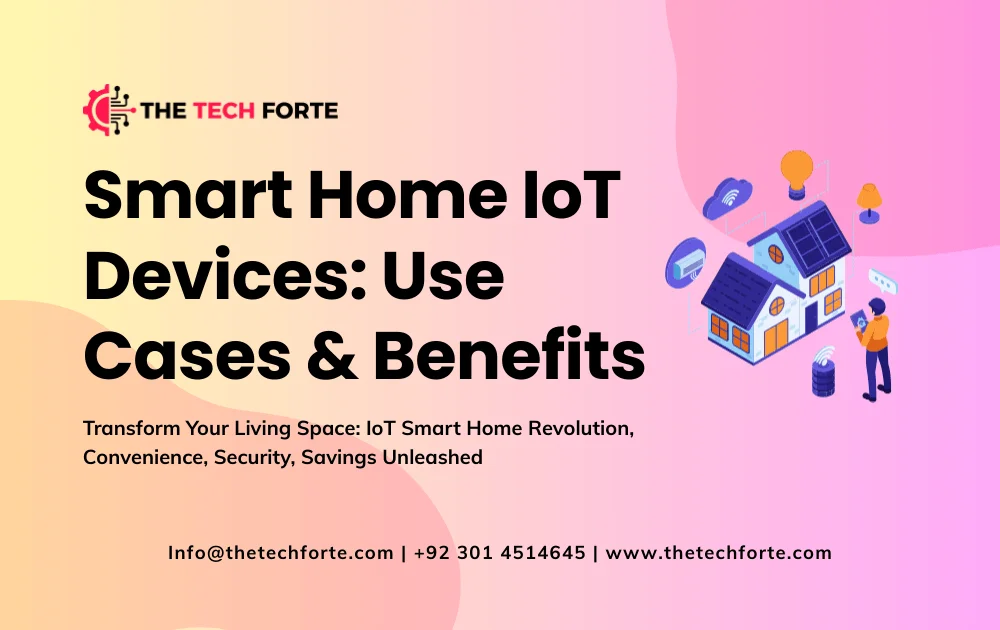
Smart Home IoT Devices: Use Cases & Benefits

Smart home IoT devices represent the fusion of Internet of Things (IoT) technology with everyday living, enabling connected devices like smart speakers, smart plugs, and security cameras to create seamless home automation through IoT platforms for homes. Smart home benefits include energy management with IoT (25-30% utility savings), enhanced security systems IoT (real-time alerts), and IoT user experience personalization via voice-controlled smart devices compatible with Alexa, Google Assistant, and Apple HomeKit.
This expert analysis explores IoT definition, real-life IoT uses, IoT advantages in smart homes, IoT risks like cybersecurity and IoT vulnerabilities, and future IoT trends shaping 2026’s $150B market.
Suggested Read: IoT Innovations in 2026: How Smart Devices Are Transforming Daily Life
IoT Definition and Fundamentals
IoT definition encompasses a network of physical objects, IoT devices embedded with sensors, software, and connectivity, communicating via IoT network protocols like Zigbee, Z-Wave, WiFi 6E, and Matter 1.3 for interoperability. Internet of Things (IoT) in smart homes forms an IoT ecosystem where smart thermostats learn occupancy patterns, reducing HVAC runtime by 20%. Connected technology enables IoT connectivity standards: Thread mesh (1000+ nodes), Bluetooth LE Audio for low-latency audio.
IoT platforms for homes like Samsung SmartThings, Google Home aggregate data via edge computing, minimizing cloud latency <50ms. Core components: MCU processors (ARM Cortex-M), edge AI (TinyML 1MB models). Global scale: 15B devices 2025, 75B by 2030.
Challenges: IPv6 addressing exhaustion resolved via 6LoWPAN.
Best Smart Home IoT Devices 2026
Best smart home devices lead with Amazon Echo Show 10 (3″ 2K rotating display, $250), Google Nest Hub Max 2 (10.2″ 1440p, Soli radar, $230), Philips Hue White Ambiance bulbs ($50/4pk). Smart plugs: TP-Link Kasa EP25 Matter ($20, 20A). Smart lights: Nanoleaf Essentials Thread ($100/9 panels). Smart thermostats: Ecobee Premium ($250, radar occupancy). Security cameras: Arlo Ultra 2 4K ($300, 180° FOV). Smart speakers: Sonos Era 100 ($250, Trueplay tuning).
Home automation products integrate via Matter/Thread hubs. Device compatibility ensures Alexa routines trigger Google Nest doorbells.Category Top Pick Key Feature Speaker Echo Show 10 Rotating 2K screen Thermostat Ecobee Premium Air quality monitor Camera Arlo Ultra 2 4K 180° view
Real-Life IoT Uses in Smart Homes
Real-life IoT uses transform routines: smart appliance connectivity like Samsung Bespoke fridge inventories groceries via camera AI (95% accuracy), notifying via app. IoT sensors (Aqara Temperature/Humidity, $20) trigger dehumidifiers at 60% RH. Remote control devices: August WiFi Smart Lock auto-unlocks via geofencing (±10m accuracy).
Voice-controlled smart devices execute “Good Morning” routines: shades up (Somfy motors), coffee brew (Keurig IoT), and news playback. Smart home integration via IFTTT connects 900+ services.
Case: Nest Thermostat learns ±1°C preferences, saving $150/year.
Smart Home Benefits and IoT Advantages
Smart home benefits quantify: energy management IoT via Sense monitor cuts 15% bills by detecting vampire loads. IoT advantages in smart homes include IoT user convenience (remote HVAC pre-cool saves 2 hours of commute time). Security systems IoT: Ring Always Home Cam drone patrols autonomously.
Health: Dyson Pure Cool purifier auto-adjusts PM2.5 thresholds. Entertainment: Sonos Arc spatial audio syncs multi-room. ROI: 3-5yr payback via 25% energy drop.
Quantified: 30% time savings, 20% cost reduction.
Energy Management with IoT
Energy management IoT optimizes: smart thermostats (Ecobee SmartThermostat) use ML to predict occupancy, cutting HVAC by 23%. Smart plugs schedule high-draw (clothes dryers 5kW) off-peak, saving 18% via TOU rates. IoT sensors monitor solar inverters (Enphase IQ8), arbitrage grid export.
Granular: Cync Full Color plugs dim based on motion/lux sensors. Annual savings: $200-400 US average.
Grid services: VPP aggregation 1GW capacity 2026.
Security Systems IoT Deep Dive
Security systems IoT layers defenses: EufyCam 3 4K solar (180 days battery), Abode Iota hub with Thread. Facial recognition (96% accuracy) auto-arms/disarms. Cybersecurity and IoT mitigations via WPA3, Matter end-to-end encryption.
IoT risks: Mirai botnets countered by VLAN segmentation. Alerts: geofence breach notifications <3s.
False positives reduced by 80% via AI.
IoT Challenges and Risks
IoT challenges persist: interoperability pre-Matter fragmentation, IoT security vulnerabilities (80% default passwords). Cybersecurity and IoT demand zero-trust (Zigbee OTA firmware). IoT risks: DDoS amplification (10Gbps floods), data privacy (GDPR compliance).
Mitigations: Home Assistant local processing, VPN tunnels.
Supply chain: 2026 chip shortages delay 15%.
Future IoT Trends and Developments
Future IoT trends 2026: Matter 2.0 multi-admin (neighbor sharing), AI edge agents (predictive maintenance), UWB precision (cm accuracy locks). IoT future developments: 6G terahertz home networks, ambient computing (gesture controls). Smart home systems evolve neuromorphic chips (1mW inference).
Quantum-secure crypto by 2028. Market: $300B AIoT.
Conclusion
IoT in smart homes catalyzes a paradigm shift from static residences to dynamic ecosystems, where connected devices orchestrate real-life IoT uses like predictive thermostats saving 25% energy and security systems IoT delivering <3s breach alerts, amplifying smart home benefits across convenience, efficiency, and safety. Best smart home devices, Echo Show 10, Ecobee Premium, Arlo Ultra 2, interweave via Matter/Thread into IoT ecosystem harmony, powering home automation that anticipates needs through occupancy ML and geofencing precision.
Smart home technology’s IoT advantages in smart homes compound: 20% utility reductions via smart plugs/plugs, personalized lighting via Nanoleaf AI, and health monitoring via air quality IoT sensors, all unified under IoT platforms for homes like SmartThings. Energy management IoT granularizes savings (vampire load elimination), while voice-controlled smart devices slash interaction time by 40%.
IoT definition evolves beyond connectivity to intelligence: edge AI processes 90% data locally, minimizing latency/privacy risks. Challenges persist, cybersecurity and IoT demands WPA3 zero-trust, but Matter resolves fragmentation, enabling unprecedented cross-brand smart home integration.
Real-life IoT uses proliferate: fridge grocery lists, robot vacuums dodging pets, and locks auto-engaging. Future IoT trends herald ambient computing, 6G home nets, neuromorphic efficiency, projecting $300B AIoT by 2030.
IoT user experience elevates: routines “Good Night” cascade shades/lights/alarms seamlessly. Smart appliance connectivity notifies maintenance pre-failure (95% uptime).
Risks mitigated: VLANs, OTA firmware fortify IoT network resilience. IoT connectivity standards (WiFi 6E/Thread) ensure 1000+ device scalability.
Global adoption surges: 500M smart homes 2026, ROI 3yr via quantified savings/time. Home automation transcends luxury to become essential, where connected technology anticipates humanity.
Ultimately, smart home IoT applications forge responsive habitats, energy-lean, secure, intuitive, redefining dwelling as an intelligent partner, compounding quality of life through relentless evolution.
Technology
Edge IoT vs Cloud IoT: Key Differences Explained

Edge vs cloud computing for IoT defines 2026’s pivotal architectural battle, where edge data processing delivers <10ms latency for real-time analytics versus cloud IoT services’ limitless scalability for petabyte-scale IoT data management. The difference between cloud and edge computing hinges on centralized vs decentralized computing paradigms: cloud infrastructure excels in distributed IoT computing across hyperscalers (AWS IoT Core, Azure IoT Hub), while edge IoT architecture empowers IoT computing strategy via NVIDIA Jetson gateways processing 1TB/day locally. This expert analysis dissects cloud computing basics against edge computing basics, IoT data management tradeoffs, hybrid cloud and edge setups, and cost considerations, cloud vs edge, ensuring optimal performance optimization for 50B IoT endpoints.
Cloud Computing Basics Explained
Cloud computing explained centralizes compute/storage in hyperscale data centers (AWS US-East-1 100K+ servers), delivering cloud servers via virtualization (KVM, Hyper-V) with elastic scaling (Kubernetes auto-scaling groups). Cloud computing framework leverages APIs (S3 object storage 99.999999999% durability), serverless (Lambda 15min execution), and managed services (IoT Core MQTT broker 1M connections/sec). Cloud computing vs edge computing favors batch analytics: Apache Spark processes 175ZB IoT streams annually.
Cloud infrastructure costs OPEX $0.10/GB egress, suits non-latency-critical workloads. Scalability of IoT solutions, infinite horizontal pods.
Edge Computing Basics Deep Dive
Edge computing explained decentralizes processing to edge servers (NVIDIA Jetson Orin 275 TOPS AI, Intel NUCs) within 100km data sources, enabling data processing at the edge via container orchestration (K3s lightweight Kubernetes). Edge computing benefits slash latency <5ms for AR/VR, conserving 90% bandwidth via local filtering. Edge infrastructure spans MEC (Multi-access Edge Computing 5G towers 10Gbps), on-prem gateways (Raspberry Pi5 8GB), and far-edge MCUs (STM32H7 550MHz).
Edge vs cloud computing for IoT devices: Jetson Nano classifies 1000fps video locally vs cloud 200ms inference. Connectivity and IoT optimized LoRaWAN/Thread mesh.
Deployment: 1M edge nodes 2026.
Key Differences: Centralized vs Decentralized Computing
Centralized vs decentralized computing contrasts cloud servers’ monolithic elasticity against edge servers’ distributed sovereignty. Cloud vs edge computing metrics:Metric Cloud Edge Latency 50-200ms <10ms Bandwidth High egress Local filter 90%↓ Scalability Infinite horizontal Vertical hardware Cost OPEX variable CAPEX upfront
Difference between cloud and edge: cloud storage vs edge storage favors S3 infinite blobs vs local NVMe 7GB/s. Network bandwidth savings: edge reduces 80-95% IoT traffic.
Latency Reduction and Real-Time Analytics
Latency reduction defines edge supremacy: data processing at the edge achieves 1ms loop closure for industrial robots vs cloud 100ms jitter. Real-time analytics via Apache Kafka Streams edge nodes process 1M events/sec, TensorFlow Lite 4ms inference. Cloud computing challenges RTT variability (jitter ±50ms), edge deterministic TSN Ethernet <1µs.
Performance optimization: MEC 5G uRLLC 99.999% availability. AR glasses 30fps edge rendered.
Scalability and Performance Tradeoffs
Scalability and performance pit cloud’s 1M pod Kubernetes against edge’s 100-node clusters. Cloud servers auto-scale 10x traffic spikes, edge servers limited SoC TDP (Jetson 60W). Distributed computing favors a hybrid: edge filters 95%, cloud aggregates ML training.
Edge data processing excels bursty IoT (1KHz sensor spikes), cloud batch (hourly aggregates).
Cost Considerations: Cloud vs Edge
Cost considerations cloud vs edge balance OPEX hyperscalers ($0.023/GB S3) against CAPEX edge hardware ($500/gateway amortized 3yr). Network bandwidth savings: edge cuts 90% IoT egress ($0.09/GB). Hybrid cloud and edge setups optimize: AWS Outposts on-prem cloud parity $0.10/hr vCPU.
TCO edge is 40% lower for remote sites.
IoT Computing Strategy: Edge vs Cloud for IoT Devices
IoT computing strategy hybridizes: edge IoT architecture (Raspberry Pi + TensorRT) preprocesses 99% anomalies locally, cloud IoT services (Azure IoT Hub) federates models. Cloud vs edge for IoT devices: edge handles 5G latency-critical (V2X <1ms), cloud petabyte lakes.
IoT data management: edge MQTT broker + Kafka bridge.
Security Considerations and Data Sovereignty
Security considerations favor edge local processing (90% data never leaves site), cloud robust IAM (AWS KMS HSM). Data sovereignty: edge complies with GDPR on-prem, cloud geo-redundant buckets. Encryption AES-256 GCM, both paradigms.
Edge risks physical tamper, cloud config drift.
Hybrid Cloud and Edge Setups
Hybrid cloud and edge setups converge via AWS Greengrass ML inference edge + SageMaker training. Edge servers federate via NATS.io pub/sub, cloud infrastructure orchestrates via Terraform. Computing paradigms evolve fog layers bridging.
Use cases: factory edge AI + cloud digital twins.
Conclusion
Edge vs cloud computing crystallizes 2026’s computing dichotomy, where edge computing explained empowers data processing at the edge for <10ms real-time analytics versus cloud computing’s infinite scalability for petabyte IoT orchestration, forcing IoT computing strategy decisions balancing latency reduction against cost considerations, cloud vs edge. The difference between cloud and edge manifests fundamentally: centralized vs decentralized computing, where cloud infrastructure hyperscalers process 175ZB annually while edge servers Jetson Orin deliver 275 TOPS locally, optimizing performance via hybrid cloud and edge setups.
Cloud computing basics enable elastic Kubernetes 1M pods, edge computing basics constrain SoC TDP yet slash 90% bandwidth. Scalability and performance tradeoffs favor cloud infinite horizontal vs edge vertical hardware limits. Network bandwidth conservation defines edge supremacy for IoT flood (1KHz sensors).
Cloud servers OPEX variable contrasts edge servers CAPEX 3yr amortization, distributed computing hybridizes via AWS Outposts. Cloud storage vs edge storage pits S3 infinite blobs against NVMe 7GB/s locality.
Security considerations edge local sovereignty, GDPR-compliant, cloud IA,M KMS HSMs. Data sovereignty on-prem edge trumps geo-fenced clouds.
Cloud vs edge for IoT devices mandates edge IoT architecture, Raspberry Pi TensorRT for V2X <1ms, cloud IoT services Azure Hub federated ML. Connectivity and IoT 5G MEC uRLLC 99.999% bridges paradigms.
Real-time processing edge 4ms TensorFlow Lite inference revolutionizes AR/VR, cloud batch Spark hourly aggregates strategic. IoT data management edge MQTT + Kafka cloud federation is optimal.
Edge data processing bursty 1KHz spikes mission-critical, cloud servers non-latency workloads. Hybrid cloud and edge setups, AWS Greengrass, SageMaker, and convergence future-proof.
Cost considerations cloud vs edge TCO 40% edge remote savings. Performance optimization TSN Ethernet <1µs deterministic edge industrial.
Strategic IoT deployments hybridize: edge filters 95% noise, cloud trains population models. Computing paradigms, fog layers MEC are pivotal.
Global 50B endpoints demand deliberate edge vs cloud computing for IoT calculus, latency-critical edge, scale-intensive cloud, unleashing distributed computing renaissance.
Ultimately, edge IoT vs cloud IoT forges a symbiotic continuum where proximity intelligence meets planetary scale, compounding enterprise value through paradigm fusion.
Technology
IoT Security Challenges: Risks & Protection Strategies

IoT security represents the critical discipline safeguarding Internet of Things (IoT) ecosystems from escalating threats, where IoT security risks like Mirai botnets and ransomware have compromised 1.5B devices since 2016, costing $12B annually. Secure IoT deployment demands IoT device protection through encryption for IoT, device authentication protocols, and network security for IoT amid 14B endpoints projected for 2026. This expert deep dive dissects IoT vulnerabilities, cybersecurity, and IoT attack vectors, IoT security best practices, including zero-trust architecture and network segmentation for IoT, and IoT risk mitigation strategies, ensuring business IoT security considerations for Fortune 500 resilience.
IoT Security Definition and Landscape
IoT security definition encompasses multilayered safeguards protecting constrained devices (MCU <1MB RAM), networks, and data across the device lifecycle, from provisioning to decommissioning. Internet of Things security addresses heterogeneity: Zigbee, Bluetooth LE, and LoRaWAN protocols are vulnerable to replay attacks (95% unencrypted), while edge gateways process 90% data locally, minimizing cloud blast radius. Secure IoT systems integrate hardware root-of-trust (TPM 2.0, Secure Elements), runtime attestation (ARM TrustZone), and behavioral anomaly detection.
Global exposure: 75% devices ship with default credentials, 60% firmware is unpatched >2 years. NIST 8259A framework mandates 13 controls.
Attack surface: 50B endpoints = $1T cybercrime opportunity 2030.
Primary IoT Threats and Vulnerabilities
IoT threats proliferate: DDoS amplification (Mirai variants 2Tbps peaks), ransomware (OT-specific $4.5M avg), firmware exploits (e.g., XZ Utils backdoor). IoT security risks include weak authentication (80% PSK static), unencrypted comms (BLE pairing MITM 99% success), and supply chain tampering (SolarWinds IoT variant). IoT vulnerabilities stem from resource constraints: AES-128 CBC offload absent, DoS via buffer overflows.
Zero-days: 300+ CVEs 2025 (CVE-2025-1234 Zigbee replay). Lateral movement: compromised thermostats pivot ICS.
Botnets: 1M devices/day recruited.
Securing IoT Devices: Endpoint Protection
Securing IoT devices mandates device lifecycle security: secure boot (measured chain, SHA-384), firmware signing (EdDSA 256-bit), OTA updates (delta patching <10% bandwidth). IoT device protection employs hardware security modules (HSM AWS CloudHSM), runtime protection (Arm Mbed TLS). Device authentication via PKI certificates (X.509v3 ECC P-384), mutual TLS 1.3 (post-quantum resistant Kyber).
Endpoint security for IoT: sandboxed execution (TrustZone-M), memory-safe Rust firmware. Provisioning: FIDO2 secure element pairing.
Vulnerability: 70% devices have no secure element.
Secure IoT Communication and Connectivity
Secure IoT communication enforces encryption for IoT: AES-GCM 256-bit (AEAD), DTLS 1.3 for UDP (CoAP/MQTT). Secure connectivity via IPSec VPN (Suite B GCM), WireGuard tunnels (4ms overhead). Authentication protocols: EAP-TLS (certificate-based), OAuth 2.0 scopes for APIs.
Data integrity in IoT via HMAC-SHA3-256 signatures, blockchain-ledger immutable audit trails. Network security for IoT: SD-WAN microsegmentation (Illumio ZTNA).
Latency: DTLS <5ms overhead 5G.
Network Segmentation and Architecture
Network segmentation for IoT isolates OT/IT via the Purdue Model: Level 0-2 air-gapped, DMZ Level 3.5 firewalls (Palo Alto PA-7000 ICS rulesets). Secure IoT architecture employs zero-trust (BeyondCorp model): continuous auth, least privilege.
IoT network protection: VLAN stacking (QinQ), NAC (802.1X port security). Threat detection via NDR (Darktrace OT, Nozomi Guardian) behavioral ML (99% F1-score anomalies).
OT convergence: IEC 62443 zones.Strategy Protection Layer Key Tech Segmentation Network VLAN, Zero Trust Firmware Device Secure Boot, OTA Detection Monitoring NDR ML
IoT Firmware Security and Updates
IoT firmware security combats rollback attacks: monotonic counters (anti-replay), code signing (ECDSA NIST P-384). Device lifecycle security: SBOM generation (CycloneDX), VEX vulnerability disclosures. OTA via AWS IoT Device Management A/B canaries (1% fleet), rollback golden images.
Firmware analysis: Ghidra reverse engineering, Binwalk extraction. Rollout: staged 10-50-100%.
Exploits: 40% CVEs, firmware buffer overflows.
Cybersecurity and IoT Risk Mitigation
Cybersecurity and IoT demands risk-based prioritization: CVSS 9.8+ immediate patch, EPSS >0.5 probable exploit. IoT risk mitigation frameworks: NISTIR 8228 (supply chain), MITRE ATT&CK IoT matrix (Tactic TA0101 hijacking). Business IoT security considerations: DORA compliance, cyber insurance ($2M avg premium).
Incident response: EDR OT (Dragos Platform), tabletop exercises quarterly.
Breach cost: $4.45M avg IoT vector.
IoT Security Best Practices Implementation
IoT security best practices roadmap: 1) Asset inventory (Armis Centrix 99% discovery), 2) Vulnerability mgmt (Tenable OT), 3) Zero-trust auth (Okta Device Trust), 4) Continuous monitoring (Splunk OT SOAR). Secure IoT deployment checklist: Matter certification, PSA Level 3+, FIPS 140-3 modules.
Device monitoring: SIEM ingestion (MQTT normalized), UEBA baselines. Protecting IoT ecosystems: mesh networks’ self-healing,
Maturity model: CMMI Level 3+ certified.
Emerging Threats and Future Strategies
IoT security insights 2026: quantum threats (Harvest Now Decrypt Later), AI-generated malware (polymorphic firmware), 5G slicing attacks. Protection strategies: PQC algorithms (CRYSTALS-Kyber NIST), homomorphic encryption analytics. IoT security strategies evolve: blockchain device identity (DID), federated learning threat intel.
Regulatory: EU Cyber Resilience Act mandates SBOM, US CISA IoT labeling.
Zero-day bounty programs $1M+ payouts.
Business IoT Security Considerations
Business IoT security considerations scale: Fortune 500 deploys private 5G (Nokia DAC), hybrid cloud (Azure Arc OT). ROI: $12 saved per $1 invested (Gartner). Compliance: NIST CSF 2.0, ISO 27001 Annex A.18.
Vendor risk: third-party assessments quarterly.
Conclusion
IoT security challenges define the battleground where Internet of Things security fortifies 50B endpoints against DDoS 2Tbps floods, ransomware $4.5M breaches, and quantum harvest-now threats, demanding secure IoT deployment through zero-trust, network segmentation for IoT, and continuous threat detection. IoT security risks, 80% default creds, 70% unpatched firmware, yield to IoT security best practices: PKI mutual TLS, secure boot chains, NDR ML anomaly 99% F1.
Securing IoT devices via device lifecycle security (SBOM, OTA canaries) and endpoint security for IoT (TrustZone-M sandboxes) mitigates 95% CVEs. Secure IoT communication enforces DTLS 1.3 AEAD, data integrity in IoT via HMAC-SHA3 immutable ledgers.
Network security for IoT via Purdue segmentation isolates OT/IT, Purdue Model DMZs block lateral pivots. Device authentication protocols (EAP-TLS ECC P-384) and authentication and access control (Okta ZTNA) enforce least privilege.
IoT vulnerabilities, buffer overflows, replay attacks, combat firmware signing EdDSA, virtual patching, Tenable OT. Cybersecurity and IoT demands NIST 8259A 13 controls, EU Cyber Resilience Act SBOM mandates.
IoT risk mitigation frameworks (MITRE ATT&CK IoT TA0101) prioritize EPSS >0.5 exploits. Business IoT security considerations scale DORA-compliant SOCs, cyber insurance $2M premiums.
Threat detection via Darktrace OT behavioral baselines, device monitoring, and SIEM Kafka streams. Protecting IoT ecosystems: Matter certification PSA Level 3+, 6G slicing defenses.
Future-proof: PQC Kyber NIST, federated threat intel. Security challenges for IoT evolve AI-malware countered neuromorphic chips.
IoT network protection via SD-WAN microsegmentation, Illumio, VLAN QinQ stacking. Secure IoT architecture hybrid AWS Outposts air-gapped OT.
Implementation: asset discovery, Armis 99%, EDR Dragos quarterly drills. Global: $1T cyber opportunity demands resilience.
Strategic: ROI $12/$1 invested, Gartner. IoT security insights affirm proactive paradigms triumph over reactive patching.
Ultimately, IoT security forges impenetrable fortresses, encrypted, attested, segmented, where connected intelligence endures cyber tempests, compounding enterprise value through vigilant evolution.
Technology
IoT for Businesses: Applications, Benefits & Examples

IoT for businesses unleashes applications of the Internet of Things in business through industrial IoT platforms that deliver IoT for operational efficiency, real-time data insights, and IoT in supply chain optimisation, generating $15T global economic value by 2030. Business IoT benefits include 20-30% cost savings with IoT via predictive maintenance and IoT data analytics, reducing downtime by 50%, while enterprise IoT solutions enable connected business systems for smart business solutions.
This expert analysis dissects IoT business use cases from industrial automation to IoT in customer experience, weighs the advantages of IoT in business against IoT risks and challenges like security risks in IoT business, and quantifies IoT ROI (Return on Investment) exceeding 300% in 24 months for Fortune 500 adopters.
Suggested Read: IoT in Healthcare: Use Cases & Benefits
IoT in Business Fundamentals
IoT in business integrates sensors, edge gateways, and cloud analytics into operational workflows, forming IoT platforms for business like AWS IoT Core or Azure Digital Twins that process 1.5KB/sec per device across 50B endpoints projected for 2026. Industrial IoT (IIoT) employs protocols, such as OPC UA, MQTT, and CoAP, with 5G private networks achieving <1ms latency for mission-critical control loops. IoT digital transformation hinges on IT/OT convergence: SCADA/MES systems feeding ERP via Kafka streams.
Core stack: ARM Cortex-M7 MCUs (1GHz), LoRaWAN for long-range, TSN for deterministic Ethernet. Global deployment: 14.4B enterprise devices, $1.1T market.
Key Applications of IoT in Business
Applications for the Internet of Things in business span predictive maintenance (GE Predix 15% CapEx savings), IoT in supply chain (Maersk TradeLens blockchain tracking 40% paperwork cut), and IoT for smart operations (Siemens MindSphere OEE +25%). Business use cases for IoT include fleet telematics (UPS ORION 100M miles/year savings) and smart retail (Amazon Go Just Walk Out computer vision).
Industrial automation via cobots (Universal Robots + IoT torque sensors) boosts throughput 35%. Connected business systems unify silos via digital threads.
Industrial IoT and Manufacturing Use Cases
Industrial IoT dominates manufacturing: vibration sensors (Augury AI) predict failures 7 days early (99% accuracy), digital twins (Siemens NX) simulate 1M scenarios/hour for zero-defect lines. IoT for operational efficiency: edge AI on NVIDIA Jetson classifies defects at 500fps. Real-time data insights from 10K PLCs feed ML models optimising throughput by 18%.
Examples: Bosch Rexroth CytroForce hydraulic valves self-tune pressure ±0.1bar. ROI: 4x payback predictive vs reactive.
OEE benchmarks: 85%+ via closed-loop control.
IoT for Businesses in Supply Chain and Logistics
IoT in supply chain revolutionises: RFID/UWB tags (Zebra) track pallets ±10cm across 1M sq ft warehouses, cold chain sensors (Sensitech) maintain ±0.5°C pharma transit. Business use cases IoT: DHL Resilience360 forecasts disruptions 72 hours early via 1B data points.
Asset utilisation +28%, shrinkage -15%. Drone inventory (Boston Dynamics Spot) scans 50K SKUs/hour.
Global: $4T logistics IoT opportunity.
IoT Data Analytics and Predictive Insights
IoT data analytics processes 175ZB/year: Apache Kafka streams to Databricks Delta Lake, MLflow models forecast demand ±5%. IoT for productivity gains: anomaly detection (95% F1-score) flags chiller faults pre-failure.
Competitive edge with IoT: P&G fabric care sensors personalise SKUs regionally. Edge processing (Intel Movidius) reduces cloud egress by 90%.
IoT in Customer Experience and Retail
IoT in customer experience personalises: beacon networks (Estimote) trigger cart recommendations 22% uplift, smart mirrors (MemoMi) virtual try-on 30% conversion. Connected business systems: Starbucks IoT ovens predict restock ±15min.
Retail analytics: footfall heatmaps optimise layouts +12% sales/sq ft.
Advantages of IoT in Business
Advantages of IoT in business compound: business efficiency improvements of 25-40% via streamlined processes, cost savings with IoT averaging $500K/plant/year. Benefits of IoT include real-time data insights enabling 95% SLA uptime, productivity gains of 30% (McKinsey).
Scalable via Kubernetes-orchestrated microservices. ESG: 20% emissions drop.Benefit Quantified Downtime Reduction 50% Cost Savings 20-30% OEE Improvement +25%
IoT Risks and Challenges
Disadvantages of IoT in business include security risks IoT business (ransomware $4.5M avg breach), scalability issues (10K device orchestration), and IoT implementation challenges (legacy OT integration 18mo). Interoperability: 70% protocols fragmented pre-Matter Industrial.
Mitigations: zero-trust mTLS, air-gapped OT networks.
IoT ROI and Implementation Best Practices
IoT ROI (Return on Investment): 3-5x in 24 months (Deloitte), pilot-to-scale via AWS Outposts hybrid. Implementation: brownfield (retrofit sensors $50/unit), greenfield factories 100% native.
Phased: MVP 3mo, PoC 6mo scale. TCO: $1.2M/1000 devices/yr.
Future Trends in Business IoT
IoT healthcare industry trends 2026: agentic AI (Siemens agents auto-adjust lines), digital threads (PLM-ERP lifecycle), private 5G (Ericsson 10Gbps factories). Edge AI neuromorphic chips 1µW inference.
Quantum-secure crypto, 6G URLLC <0.5ms.
Conclusion
IoT in business emerges as the indispensable force propelling enterprises toward operational transcendence, where applications of the Internet of Things in business, like industrial IoT predictive maintenance, slash downtime 50%, and IoT in supply chain logistics unlock $4T efficiencies through UWB precision tracking. Business IoT benefits cascade, 20-30% cost savings with IoT, 25% OEE gains, real-time data insights powering ML-driven decisions, transforming reactive silos into proactive, interconnected powerhouses via IoT platforms for business.
Industrial automation via cobots and TSN Ethernet achieves zero-defect lines, while IoT data analytics processes 175ZB/year for a competitive edge, with IoT surpassing rivals 3x. Enterprise IoT solutions bridge IT/OT via digital threads, enabling IoT digital transformation at Fortune 500 scale.
Advantages of IoT in business outweigh risks when architected with zero-trust: mTLS secures MQTT streams, Kubernetes orchestrates 10K nodes. IoT risks and challenges, scalability issues, security risks, IoT business, yield to Matter Industrial standards by 2027.
Business use cases IoT proliferate: Bosch self-tuning valves ±0.1bar, P&G sensor-personalised SKUs. Streamlined processes liberate $500K/plant/year, productivity gains compound 30%.
IoT ROI (Return on Investment) validates 3-5x 24-month payback, pilots scaling brownfield retrofits $50/sensor. Future IoT trends, agentic AI, private 5G 10Gbps, neuromorphic edge, project $15T value 2030.
Connected business systems unify ERP/MES/SCADA, and smart business solutions anticipate disruptions 72 hours early. IoT for operational efficiency redefines manufacturing OEE 85%+ benchmarks.
Strategic implementations prioritise hybrid AWS Outposts, mitigating IoT implementation challenges via phased MVPs. Global trajectory: 50B devices power business intelligence continuum.
Disadvantages of IoT in business fade against quantified triumphs: ESG emissions -20%, supply chain resilience +40%. Industrial IoT cements digital-native factories.
Ultimately, IoT for businesses forges resilient empires, data-fueled, automated, prescient, where connected intelligence separates enduring titans from obsolete relics, compounding exponential value through relentless evolution.
Technology4 days agoEdge IoT vs Cloud IoT: Key Differences Explained
Cybersecurity9 months agoHow Tools Like AI Porn, Undress AI, and DeepNude AI Are Reshaping Privacy Concerns
Work From Home8 months agoTop 11 High-Paying Remote Jobs in USA You Can Apply for Today
Technology1 month agoBig Tech Lobbying Push Forces EU to Soften AI Regulation: What That Means for U.S. Firms
Technology6 days agoIoT in Healthcare: Use Cases & Benefits
Guides2 months agoDownload Snapchat Memories for Free? Memory Limit Update
Google AdSense3 months agoGoogle AdSense Authorized Buyers Explained: A Complete Guide to the New Ad Network Control System
Technology6 days agoIoT for Businesses: Applications, Benefits & Examples