AI Humanoid Robots: How Human-Like Machines Will Shape Life by 2035

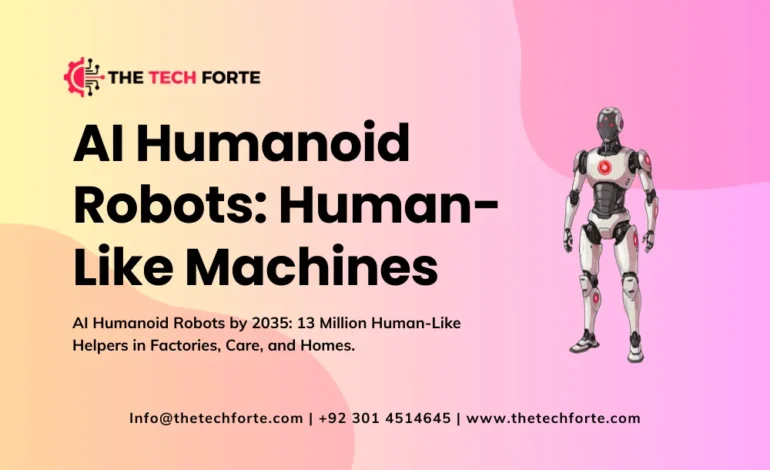
By 2035, the human world will no longer be the only one shaping cities, factories, homes, and hospitals. Powered by artificial intelligence, AI humanoid robots, machines that walk, talk, and act like people, are on track to move from science fiction into the mainstream, transforming work, care, and daily life on a planetary scale.
The widely cited Morgan Stanley forecast predicts that 13 million humanoid robots will work alongside humans in factories, warehouses, care homes, and retail by 2035, with costs collapsing to levels that could make them affordable humanoid robots, comparable to cars or even mid-range smartphones over time.
This is not just a surge in factory robots; it is the dawn of robots working alongside humans in places built for people: offices, homes, streets, and hospitals. Behind this wave is deep AI and robotics integration, where AI, machine learning, biomechanics, and advanced robot sensors converge into what experts now call physical AI or embodied intelligence, machines that perceive, reason, act, and learn in the physical world.
This 3,000+ word expert analysis explains how and why AI humanoid robots will become a normal part of life by 2035. We will cover:
- The core technologies of AI humanoid robots, including AI and robotics integration, machine learning for robots, sensor integration, and processor advancements
- How 13 million** AI humanoid robots by 2035** is a plausible scenario, according to Morgan Stanley’s robotics forecast and robotics market growth projections
- Real-world real-world robot applications in logistics, manufacturing, health care, rescue, and homes
- Robot workforce growth and robotics in factories and care, including robotics in industry and home
- The economic and ethical impact of robots, from robot workforce forecast and workforce transformation to ethical and regulatory concerns and debates over robots for homes and industry
- What a 2035 world with AI humanoid robots would actually look and feel like, and how deeply these human-like form and interaction systems will reshape society.
From Science Fiction to Real-World AI Humanoid Robots
For decades, humanoid robots lived only in movies and labs: relatable figures like R2‑D2, Wall‑E, and C‑3PO, or advanced research platforms like Honda’s ASIMO. But in 2024–2026, a critical shift is happening: AI humanoids (often called “humanoid robots” or simply “humanoids”) are moving from show pieces to production machines, deployed in real factories, warehouses, and pilot programs in care homes and hospitals. This is the transition from science fiction to real robots.
Key milestones around 2025–2026:
- Companies like Tesla (Optimus), Figure AI, Apptronik (Apollo), Agility Robotics (Digit), 1X (A1, Neo), Boston Dynamics (Atlas), UBTECH, and Hanson Robotics (Sophia) have moved from lab prototypes to limited deployments in warehouses, logistics centers, and manufacturing.
- Major automakers (BMW, Honda, Hyundai, Nissan) and logistics giants (Amazon, UPS, DHL, JD) are testing humanoids in sorting, bin‑picking, palletizing, and parts assembly tasks.
- Health‑tech and eldercare firms are piloting humanoids as assistants in healthcare, logistics, rescue, and rehabilitation settings, where they help with mobility support, monitoring, and repetitive physical tasks.
These robots are no longer “dancing for 5 minutes and then turning off.” They are designed to run for 8–12 hours on a shift, charging autonomously, reporting errors, and learning from each work cycle.
The Technology Behind AI Humanoid Robots
To understand why AI humanoid robots are becoming practical by 2035, we must examine the four pillars of their technology: AI and robotics integration, robotics engineering, sensor integration, and processor advancements.
1. The Brain: AI, Machine Learning, and Physical AI
The intelligence in modern AI humanoid robots comes from AI and robotics integration using physical AI (also called embodied intelligence): AI systems that do not just process text and images, but also plan, move, and adapt in the physical world.
Three core ideas:
a) Multimodal VLA (Vision‑Language‑Action) Models
Modern humanoids use vision‑language‑action (VLA) models that combine:
- Computer vision (recognizing objects, people, and obstacles),
- Natural language processing (NLP) (understanding spoken or written instructions), and
- Motor control (planning which joints to move, how much force to apply, and how to balance).
Instead of hard‑coded “if‑then” rules, a robot is now shown examples of behaviors (e.g., “pick up a box and place it on a shelf”) and learns by observing and imitating, just like humans do. This is the AI machine learning backbone of systems like Figure AI’s robot, Tesla Optimus, and 1X’s A1.
b) Learning from Simulation and Real Experience
Humanoids learn in two phases:
- Offline in simulation: Massive physics simulations teach the robot how to walk, balance, pick up objects, and avoid falling under thousands of conditions.
- Online in the real world: Real robots perform tasks while collecting data, which is fed back to improve the AI models (a “real‑world robot learning loop”).
This allows rapid improvement: a robot might fail in the real world, learn from the error, and perform better on the next attempt.
c) Reasoning and Planning: “Agentic AI” for Robots
The next frontier is agentic AI, robots that can:
- Understand high‑level goals (“Clear this area for the morning shift”),
- Break them into sub‑tasks (“Move boxes A‑F from shelf 1 to pallet 1, then clean the floor”),
- Handle interruptions (e.g., a person walking through a doorway),
- Ask for help or clarification when stuck.
This kind of AI combining perception, action, and reasoning is what makes humanoids capable of truly working alongside humans in semi‑ or unstructured environments, not just repeating the same motion on a production line.
2. The Body: Robotics Engineering and Human-like Form
Robotics engineering for humanoids is a delicate balance of mechanics, electronics, and materials, all packed into a human‑like form that can operate in human spaces.
Why the Human-like Form?
A humanoid form (2 legs, 2 arms, head, torso) is not chosen for aesthetics alone; it is a practical design for human environments:
- It fits through standard doorways, hallways, and stairs.
- It can operate human tools (for example, a forklift, a shopping cart, or a kitchen knife).
- It can work at human workstations without costly re‑engineering of the factory floor or office.
This is the essence of humanoid robots vs. traditional industrial robots, which are often confined to cages and require custom environments.
Key Engineering Challenges
- Bipedal locomotion: Walking on two legs is incredibly hard from a control perspective. Humanoids use:
- Inertial sensors (IMUs) for balance,
- Force/torque sensors in joints and feet to sense contact with the ground,
- Advanced control algorithms that adjust leg angles and body posture in real time.
- Manipulation and dexterity: Human hands have 27+ degrees of freedom; today’s robot hands are simpler but still highly capable for tasks like:
- Grasping differently shaped objects (boxes, bottles, clothes),
- Applying variable force (lifting heavy boxes vs. handling delicate items),
- Working with tools and human interfaces (touchscreens, switches, appliances).
- Power and energy:
- Humanoids today typically run on large lithium‑ion or lithium‑polymer batteries, good for 4–10 hours per charge depending on activity.
- Future humanoids will likely use higher‑density batteries (e.g., silicon‑carbon, solid‑state) and dynamic charging (swapping or topping up in downtime).
3. The Senses: Sensor Integration
Modern AI humanoid robots are packed with sensors to see, hear, touch, and understand the world:
- Cameras (2D and 3D/depth): For object detection, obstacle avoidance, person identification, and environment mapping.
- LiDAR and 3D depth sensors: For precise distance measurement, mapping, and navigation in complex spaces.
- Microphones and audio systems: For voice commands, ambient noise classification, and human‑robot interaction.
- Inertial sensors (accelerometers, gyroscopes, IMUs): For balance, coordination, and fall prevention.
- Force/torque sensors (in joints, wrists, feet): To sense contact, grip strength, and ground reaction forces.
- Temperature and environmental sensors: To detect heat, pressure, hazardous gases, and other conditions in industrial and rescue environments.
All these senses feed data into the AI combining perception, action, and reasoning, enabling the robot to react to its surroundings in real time rather than following a rigid script.
4. The Nervous System: Processor Advancements and Onboard Computing
To run sophisticated AI, manipulation, and navigation in real time, AI humanoids need powerful onboard computing:
- AI chips and NPUs: Modern humanoids use mobile‑class or custom AI accelerators optimized for running large models (LLMs, VLA, 3D vision) at low power and latency.
- Edge computing: Rather than relying on constant cloud connectivity, many systems now run most AI locally on the robot (“on‑device AI”) to ensure:
- Fast reaction times (critical for safety),
- Operation in low‑bandwidth or unstable networks,
- Data privacy (sensitive video/audio can be processed locally).
This processor advancements allows humanoids to operate autonomously, make decisions in seconds, and recover from failures without waiting for cloud round‑trips.
The 13 Million Robots by 2035: Morgan Stanley Forecast & Robotics Market Growth
The headline number behind the 2035 AI revolution is this: 13 million humanoid robots by 2035, working in factories, warehouses, care, and other industries, according to Morgan Stanley robotics forecast and related analyses by firms like Goldman Sachs, Barclays, and Deloitte.
1. The Numbers: Robotics Market Growth 2025–2035
- Current state (2024–2026): Fewer than 10,000 humanoids are deployed globally, mostly in pilot programs, research, and small warehouse trials.
- Morgan Stanley’s 2035 forecast: Around 13 million humanoid robots in service, primarily in:
- Manufacturing and assembly,
- Warehousing and logistics,
- Transportation and last‑mile delivery,
- Health care and rehabilitation,
- Public services and security.
- Market value:
- By 2035: ~$38–50 billion global market for humanoid robots (hardware + software + services),
- By 2050: $1.4–5 trillion in annual revenue, rivaling or exceeding the automotive industry.
These numbers imply a compound annual growth rate (CAGR) of 30–40% over the next decade, driven by both technological progress and macro trends.
2. Why 2035? Drivers of Robot Workforce Growth
Four key forces explain why robot workforce growth will accelerate from 2025 to 2035:
a) Demographic and Labor Shortages
- Aging populations in Japan, South Korea, China, and Europe are shrinking the working‑age population while increasing demand for elder care, health services, and in‑home support.
- Labor shortages in logistics, manufacturing, construction, and service sectors make it hard to hire and retain human workers, especially for repetitive, physically taxing, or dangerous jobs.
Humanoids can fill roles that are:
- Hard to staff (e.g., overnight warehouse shifts, long‑haul delivery, nursing assistants),
- Dangerous (e.g., firefighting, disaster rescue, high‑voltage work, chemical handling).
b) Falling Costs: Toward Affordable Humanoid Robots
Currently, one humanoid robot can cost $100,000–200,000, but Morgan Stanley, Deloitte, and others predict a steep cost decline:
- By early 2030s, material cost per unit could fall to $13,000–17,000, with end‑user prices dropping to $20,000–40,000 in many markets.
- In China and other regions with strong robotics supply chains, prices could reach $10,000–15,000 per robot, making them affordable humanoid robots for mid‑size businesses and eventually for wealthy households.
This cost curve is driven by:
- Mass production of key parts (actuators, batteries, AI chips),
- Open‑source robotics stacks and reusable “robot brains” across different models,
- Competition among dozens of startups and established players.
c) Technology Maturation: From Labs to Factories
By 2025–2035, the reliability, safety, and efficiency of humanoids will improve to the point where they can handle:
- Millions of work cycles in a factory or warehouse,
- Long hours in diverse environments (hot, cold, dusty, wet),
- Mixed collaboration with humans, not just isolated “safe” cells.
Regulators, insurers, and safety standards bodies will evolve to support large‑scale deployment, turning today’s “pilots” into tomorrow’s standard fleets.
d) Scalability and Robot Fleet Orchestration
Just as cloud platforms and Kubernetes manage thousands of servers, AI and robotics integration in 2030s will manage robot fleets of thousands of humanoids across:
- Global factories and distribution centers,
- Fleet‑based logistics (delivery, cleaning, inspection),
- Urban and home services.
A single command center could:
- Monitor thousands of robots,
- Assign tasks based on worker availability and workload,
- Update software and AI models in real time,
- Predict and prevent failures.
This robot fleet orchestration is what makes 1 million+ humanoids economically viable, not just technically possible.
Real-World Robot Applications: Factories, Care, and Beyond
The 2035 world of AI humanoid robots will be defined by concrete, useful applications, not just futuristic demos. Here is how they will be used in practice.
1. Robotics in Factories and Warehouses
Manufacturing and logistics are the first proving ground for robots working alongside humans and robotics in industry.
Use cases:
- Bin picking and sortation: Humanoids pick boxes, clothes, or small parts from bins and place them on conveyors or pallets.
- Assembly and quality control: Humanoids perform repetitive hand‑assembly tasks (e.g., electronics, automotive parts) and visually inspect products.
- Material handling: Moving pallets, trolleys, and containers between stations, including loading/unloading trucks.
- Maintenance and inspection: Walking through factory floors, checking for leaks, overheating, or misalignment, and reporting issues.
Benefits:
- 24/7 operation, filling shift gaps,
- Reduced human exposure to repetitive strain injuries,
- Faster order fulfillment and fewer errors.
By 2035, a large warehouse may run with a few human supervisors overseeing dozens of humanoids, effectively creating a robot workforce that scales with demand, not with hiring cycles.
2. Robotics in Care and Healthcare
Healthcare and eldercare are among the most profound and socially sensitive areas for AI humanoid robots.
Use cases:
- Elderly and disability care:
- Helping seniors stand, walk, and move around rooms,
- Assisting with eating, dressing, and hygiene,
- Reminding about medication, water, and appointments,
- Providing companionship and reducing loneliness.
- Physical and cognitive rehabilitation:
- Guiding patients through physiotherapy exercises,
- Providing real‑time feedback and motivational support,
- Tracking progress and adapting difficulty over time.
- Hospital support:
- Delivering medicine, meals, and supplies to nurses,
- Disinfecting rooms with UV or sprayers,
- Escorting patients and visitors to destinations.
- Mental health and companionship:
- Engaging in structured conversations and games,
- Recognizing signs of distress (via voice, facial expression, movement) and alerting caregivers.
Benefits:
- Alleviating chronic understaffing in nursing homes and hospitals,
- Improving quality of life for isolated or disabled individuals,
- Freeing human caregivers to focus on complex, emotionally demanding tasks.
Critically, these robots are not meant to replace human caregivers, but to work alongside humans, handling the most physically taxing, time‑consuming tasks so that nurses and doctors can focus on treatment, empathy, and decision‑making.
3. Rescue, Security, and Public Services
In high‑risk environments, humanoids can save lives by replacing or assisting humans.
Use cases:
- Disaster rescue: Entering collapsed buildings, nuclear or chemical sites, or fire zones to search for survivors when it is too dangerous for humans.
- Extreme‑condition inspection: Climbing towers, entering confined spaces, or working in deep mines, undersea, or at high altitudes.
- Public security and patrol:
- Walking or driving patrols in public spaces, airports, or industrial zones,
- Detecting suspicious activity, unauthorized access, or environmental hazards,
- Calling for human intervention and guiding responders.
- Emergency response support:
- Delivering supplies, medical kits, or communication tools to disaster zones,
- Serving as mobile communication hubs or temporary shelters.
Benefits:
- Reducing risk to human responders,
- Operating effectively in environments that are hot, cold, dark, or toxic,
- Deploying rapidly in large numbers during crises.
4. Robots in Homes and Daily Life
By 2035, humanoids will begin to enter homes, especially in regions with aging populations.
Use cases:
- Household chores:
- Cleaning floors, windows, bathrooms, and kitchens,
- Doing laundry, folding clothes, and putting them away,
- Loading and unloading dishwashers.
- Meal preparation and service:
- Preparing simple meals (stir‑fry, salads, soups)
Conclusion: The Dawn of the Humanoid Era
AI humanoid robots are no longer a speculative dream; they are a 2025–2035 technological and economic reality, driven by AI and robotics integration, physical AI, sensor and processor advancements, and a global push for automation.
The Morgan Stanley robotics forecast of 13 million humanoid robots by 2035 is a reasonable estimate if current trends in cost, reliability, and social acceptance continue. In manufacturing, logistics, healthcare, rescue, and homes, AI humanoid robots will become essential tools for handling labor shortages, reducing physical strain, improving safety, and delivering services at scale.
However, the real test of this era will not be how many robots we build, but how wisely we use them. The 2035 world will be defined by choices: how we share the economic impact of robots, how we protect jobs and human dignity, and how we govern AI humanoid robots in a way that is safe, ethical, and inclusive. With the right policies, values, and vision, a world of 13 million humanoids by 2035 can be a world of greater abundance, less drudgery, and more human flourishing than ever before.