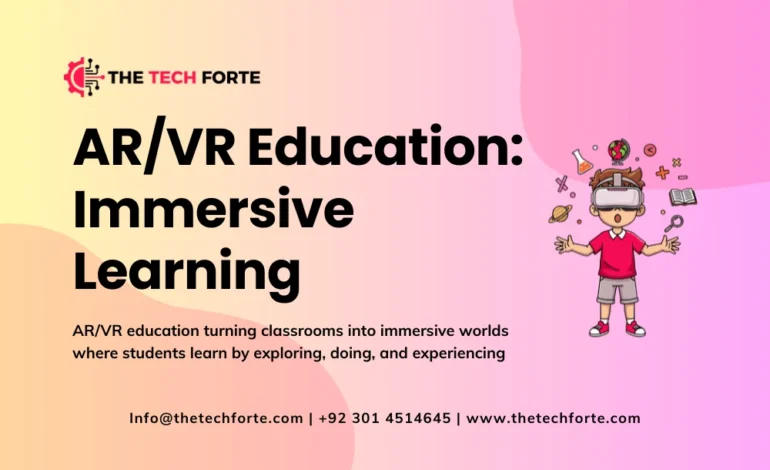
AR/VR Education: Immersive Learning Experiences Explained

Augmented Reality and Virtual Reality AR VR in education are reshaping classrooms into immersive learning environments where students can manipulate 3D content, enter virtual field trips, and learn by doing instead of just listening or reading.
These immersive education technologies, often grouped under Extended or Mixed Reality (MR), enable immersive learning experiences that boost student engagement & motivation, deepen understanding through experiential learning, and build critical thinking development across K‑12, higher education, and corporate training.
1. What is AR/VR education and immersive learning?
AR/VR education refers to the use of Augmented Reality (AR), Virtual Reality (VR), and Mixed Reality (MR) tools to create immersive learning experiences that blend digital content with physical or virtual spaces.
- Augmented Reality (AR) in education overlays 2D or 3D digital content, such as AR 3D models & overlays, onto the real world using phones, tablets, or headsets.
- Virtual Reality (VR) in education places students inside fully virtual environments via head‑mounted displays, enabling VR simulations & 360° experiences and interactive 3D environments that feel spatial and real.
- Mixed Reality (MR) merges physical and virtual objects so learners can interact with both simultaneously (for example, seeing a virtual molecule anchored to a real lab bench and manipulating it with gestures).
Together, these immersive education technologies create immersive experiences for education where students can explore, experiment, and collaborate in ways not possible with flat textbooks or 2D screens.
2. Why environments matter
Research on immersive learning environments shows that AR/VR can significantly enhance student engagement & motivation and increased knowledge retention when used thoughtfully.
2.1 Student engagement & motivation
Studies and meta‑analyses indicate that VR and AR in education increase cognitive, emotional, and behavioral engagement.
- Interactive learning activities encourage active participation instead of passive listening.
- Novel immersive experiences capture attention and sustain interest, especially in difficult subjects.
- Gamified or narrative‑driven VR simulations can improve motivation and satisfaction compared to traditional lectures.
These factors contribute to improved academic outcomes when immersive experiences are aligned with clear objectives and supported by good pedagogy.
2.2 Increased knowledge retention and experiential learning
Immersive learning strongly supports experiential learning, “learning by doing”, which research links to increased knowledge retention.
- VR simulations & 360° experiences let students practice procedures or experience events first‑hand, embedding concepts in memory through action.
- AR 3D models & overlays help explain abstract concepts (for example, anatomy, molecules, or mechanical systems) in spatial, manipulable form, supporting enhanced problem‑solving skills.
A meta‑analysis of immersive learning environments found that VR, in particular, can significantly improve retention and application of knowledge versus traditional methods when experiences are well designed.
2.3 Critical thinking development and problem‑solving
AR/VR environments support critical thinking development and problem‑solving by:
- Presenting open‑ended challenges where students must interpret information, test hypotheses, and refine strategies.
- Allowing safe failure in simulations (e.g., a virtual chemistry lab or medical procedure) so learners can explore consequences and iterate.
- Encouraging collaboration and communication in multiplayer immersive scenarios.
This aligns with 21st‑century skills goals, where immersive learning experiences are used to build analytical and decision‑making abilities, not just recall.
3. Key AR/VR tools and learning scenarios
Immersive learning technology spans a range of hardware and software experiences.
3.1 VR simulations & 360° experiences
VR simulations & 360° experiences are among the most powerful VR applications in education:
- In STEM, VR simulations let students perform complex experiments, navigate 3D anatomical models, or explore atomic structures in safe, repeatable environments.
- In history and cultural experiences, learners can “re‑live” past events, such as prehistoric communities or historic cities, through immersive virtual reality learning experiences that place them inside reconstructed environments.
- 360° videos and interactive tours offer low‑barrier immersive experiences for schools with more limited hardware.
These experiences support interactive learning and experiential learning by making abstract or distant content tangible.
3.2 AR 3D models & overlays
AR 3D models & overlays use mobile devices or AR headsets to project digital objects into physical classrooms:
- In biology, students can view and rotate animated hearts, cells, or organs in 3D, exploring internal structures by “peeling back” layers.
- In physics and engineering, AR overlays can show forces, vectors, and fields superimposed on real setups.
- AR flashcards, posters, and textbooks come alive with 3D content when scanned, turning standard materials into interactive learning tools.
This spatial visualization enhances comprehension, especially for students who struggle with purely symbolic representations.
3.3 Virtual field trips
Virtual field trips take students to places that would otherwise be inaccessible:
- Virtual tours of Mars, deep‑sea ecosystems, or endangered habitats.
- Visits to museums, archaeological sites, or historic events with guided narration and interactive tasks.
- Virtual campus tours for prospective university students, letting them explore facilities and student life remotely.
Virtual field trips count among immersive experiences for education that lower cost and logistical barriers while broadening exposure to global contexts.
3.4 Interactive 3D environments and hands‑on virtual labs
Interactive 3D environments and hands‑on virtual labs & scenarios allow:
- Chemistry or physics labs to be simulated in VR, where students can mix chemicals, build circuits, or test designs without risk or consumable costs.
- Medical and nursing students to practice procedures and diagnosis in realistic VR simulations before working with real patients.
- Engineering students to prototype mechanisms or structures and test them under virtual stress conditions.
These hands‑on virtual labs integrate experiential learning and enhanced problem‑solving skills into subjects where real equipment is scarce or expensive.
3.5 Immersive projection mapping and sensory rooms
Immersive projection mapping turns entire rooms into interactive environments using multi‑surface projectors:
- Walls, floors, and ceilings become a single canvas, surrounding learners with dynamic visual content.
- In sensory rooms for special needs education, projection mapping and interactive surfaces can create calming or stimulating environments tailored to individual needs.
These immersive learning environments enable collective experiences, blending the benefits of VR immersion with shared physical presence.
3.6 Real-time interactive tools
Various platforms offer real-time interactive tools such as:
- Collaborative whiteboards and 3D annotation in VR classrooms.
- Real‑time feedback and analytics on student actions inside immersive experiences.
- Instructor tools for guiding, pausing, or rewinding simulations during group instruction.
Real‑time interaction ensures that AR/VR is integrated into teaching rather than used as isolated “wow” moments.
4. Where AR/VR education shines: subject examples
4.1 STEM education enhancement
AR/VR is particularly powerful for STEM education enhancement
- In science, VR labs and AR overlays allow safe exploration of hazardous experiments, complex systems, or microscopic structures.
- In technology and engineering, students can practice coding robots or designing circuits within interactive 3D environments.
- Mathematics concepts like 3D geometry, vectors, and surfaces can be visualized and manipulated in MR.
These immersive learning experiences make abstract STEM concepts more concrete and intuitive.
4.2 History and cultural experiences
History and cultural experiences benefit from immersive storytelling:
- VR historical simulations let students experience events or eras (e.g., prehistoric villages, ancient Rome, or art galleries) with contextual cues and narratives.
- AR in museums and heritage sites overlays digital reconstructions of ruined structures or lost artifacts on their physical remnants.
Students build empathy and contextual understanding by “being there,” which enhances both knowledge retention and critical thinking development about sources, perspectives, and interpretations.
4.3 Teacher professional development
Teacher professional development can also leverage immersive education technologies:
- VR classrooms where educators practice classroom management, inclusive teaching strategies, or responses to challenging scenarios.
- AR/VR training modules for new tools or curricula, allowing teachers to experience content as students would.
- Mixed Reality workshops where teachers design and test immersive lessons.
These applications support personalized learning experiences for educators themselves and help address the need for teacher training around immersive tools.
4.4 Virtual campus tours and student onboarding
Universities and colleges use virtual campus tours to:
- Show prospective students around campus, classrooms, labs, and accommodations, regardless of location.
- Provide orientation experiences for admitted students, easing the transition and reducing anxiety.
These immersive experiences for education support global recruitment and inclusion of international and remote students.
4.5 Corporate and vocational training use
AR/VR is increasingly used in corporate and vocational training:
- VR simulations for safety procedures, equipment operation, and emergency response.
- AR overlays for on‑the‑job guidance in manufacturing, logistics, or maintenance (step‑by‑step instructions visible in the worker’s field of view).
- Soft skills training in VR, such as presentations, negotiations, or customer service simulations.
This aligns with immersive learning experiences focused on real‑world upskilling, where immersive education technologies support both technical and soft skills.
5. Impact on learning outcomes and skills
5.1 Improved academic outcomes
Research across multiple studies indicates that immersive learning environments can lead to improved academic outcomes when integrated thoughtfully.
- Students show better performance on assessments measuring understanding and application of concepts compared to traditional instruction alone.
- Immersive experiences help address diverse learning styles by combining visual, auditory, and kinesthetic modalities.
However, outcomes depend heavily on instructional design and alignment with curriculum objectives.
5.2 Enhanced problem-solving skills and critical thinking development
AR/VR scenarios often involve dynamic, complex situations:
- Students must interpret incomplete information, explore options, and make decisions, thereby strengthening enhanced problem‑solving skills.
- Critical thinking development is supported through simulations that ask “what if?” and encourage reflection on consequences and ethics (for example, in history, medicine, or environmental science).
These capabilities are difficult to cultivate via static content alone.
5.3 Personalized learning experiences
Immersive platforms can enable personalized learning experiences:
- Adaptive VR simulations adjust difficulty or guidance based on learner performance.
- Students can choose pathways within immersive scenarios, focusing on topics or roles that interest them.
- Data from student interactions can be used to tailor follow‑up tasks, feedback, and real‑world practice.
This personalization supports both struggling learners, who may need more scaffolding, and advanced learners seeking deeper challenges.
6. AR/VR education market growth and adoption trends
6.1 AR/VR education market growth and forecast to 2030
Market research indicates that the AR/VR education market is expanding rapidly:
- One report projects the AR/VR in education market to grow from about USD 2.4 billion in 2024 to roughly USD 22.5 billion by 2030, a CAGR of around 41.2%.
- Drivers include advances in immersive hardware, lower headset costs, higher internet penetration, and the broader shift toward digital education and training.
This growth reflects increasing adoption of immersive education technologies across K‑12, higher education, and corporate sectors.
6.2 Adoption in K‑12 and higher education
Adoption in K‑12 and higher education is accelerating but uneven:
- K‑12 schools use class‑set VR headsets, AR‑enabled textbooks, and immersive labs, often starting with pilot programs.
- Higher education institutions deploy VR simulations for medicine, engineering, and arts, and AR for lab enhancement and design disciplines.
While early adopters show strong results, widespread integration still faces structural and budgetary challenges.
6.3 Corporate and vocational training use
Corporate and vocational training use is expected to remain a major driver:
- Industries with high safety and training costs (energy, manufacturing, healthcare, aviation) gain significant ROI from VR simulations and AR guidance.
- VR/AR supports scalable, repeatable training with consistent quality, especially for global workforces.
This sector helps fund content development and platform maturity that eventually benefits education providers as well.
7. Barriers and challenges to AR/VR education
Despite their promise, immersive experiences for education face real challenges.
7.1 High cost of equipment and infrastructure
The high cost of equipment and barriers: cost & infrastructure are major obstacles:
- Quality VR headsets, MR devices, and capable PCs or consoles require significant upfront investment.
- Schools must budget for maintenance, replacements, device management, and sanitization.
- Reliable high‑bandwidth networks and storage are needed for VR simulations & 360° experiences.
While mobile‑based AR reduces entry cost, more advanced immersive learning environments still demand meaningful resources.
7.2 Accessibility & equity issues
Accessibility & equity issues arise from unequal access to devices, connectivity, and accessible designs:
- Students in under‑resourced schools or remote regions may lack compatible hardware or broadband.
- Some headsets can be uncomfortable or unusable for learners with certain disabilities or visual conditions.
- AR/VR experiences need inclusive design features, adjustable fonts, captions, audio descriptions, and alternative interaction modes.
Without deliberate planning, immersive education technologies risk widening rather than narrowing existing gaps.
7.3 Need for teacher training
There is a strong need for teacher training:
- Teachers need time and support to learn how to operate hardware, navigate platforms, and troubleshoot issues.
- Pedagogical training is required to design lessons that integrate AR/VR meaningfully rather than using them as stand‑alone gimmicks.
- Professional development must address lesson planning, assessment, and classroom management in immersive contexts.
Investing in teacher professional development is essential to unlock the full potential of immersive learning experiences.
7.4 Curriculum integration challenges
Curriculum integration challenges include:
- Aligning immersive experiences with standards, learning outcomes, and assessment frameworks.
- Ensuring AR/VR content is age‑appropriate, accurate, and culturally sensitive.
- Avoiding overreliance on technology and maintaining balance with other teaching methods.
Effective integration requires collaboration among educators, instructional designers, and technologists.
8. Looking ahead: immersive education technologies and the classroom of the future
As AR/VR education and immersive learning environments mature, several trends are emerging:
- Blended XR classrooms where AR overlays, VR sessions, and traditional activities coexist in a coherent learning design.
- AI‑enhanced immersive learning where student interactions in VR/AR feed into adaptive systems that personalize content and feedback.
- More affordable, standalone headsets and lightweight AR glasses that reduce cost and complexity.
- Cross‑platform content that runs on headsets, tablets, and browsers, increasing accessibility.
Forecasts to 2030 suggest that immersive education technologies will move from pilot projects to mainstream tools in many contexts, especially as costs decline and teacher training improves.
Conclusion: AR/VR as a powerful, but not magic, tool
Augmented Reality (AR) in education, Virtual Reality (VR) in education, and Mixed Reality (MR) are powerful immersive education technologies that enable immersive learning experiences far beyond what traditional classrooms can offer.
From VR simulations & 360° experiences and AR 3D models & overlays to virtual field trips, hands‑on virtual labs & scenarios, and immersive projection mapping, these tools support interactive learning, experiential learning, and personalized learning experiences that drive student engagement & motivation, increased knowledge retention, and improved academic outcomes across STEM education enhancement, history and cultural experiences, teacher professional development, and corporate and vocational training.
At the same time, realizing the full promise of immersive learning environments will require addressing accessibility & equity issues, high cost of equipment, teacher training needs, and curriculum integration challenges so that AR/VR education market growth benefits all learners, not just a few.
When implemented thoughtfully, AR/VR education is less about flashy headsets and more about designing meaningful immersive experiences for education that build enhanced problem‑solving skills and critical thinking development, preparing students for a world where understanding, adaptability, and hands‑on digital fluency are as essential as content knowledge itself.