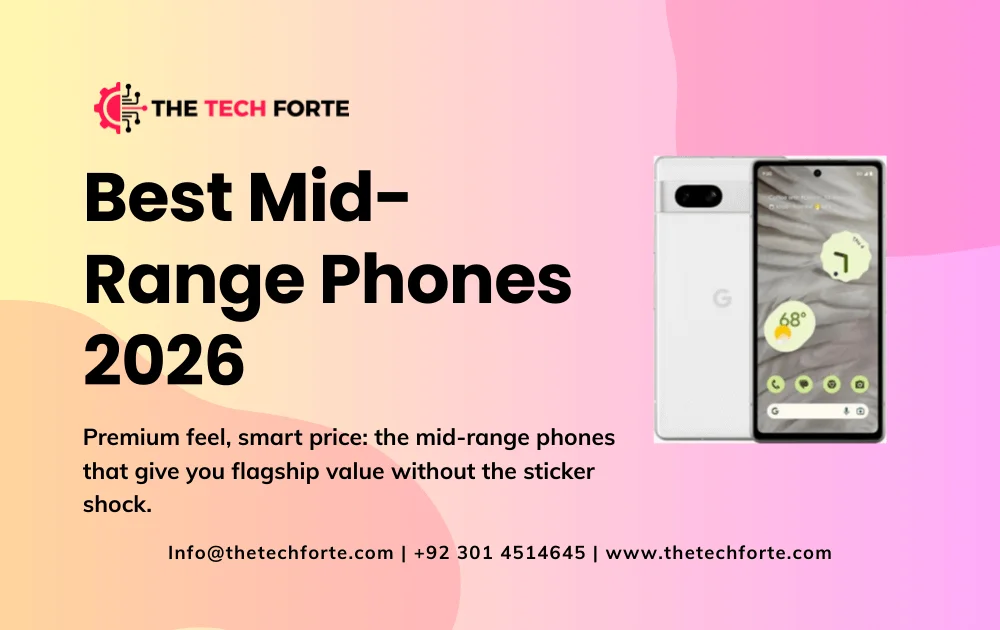
Best Mid-Range Phones 2026: Top Picks for Performance, Camera & Battery Life

The best mid-range phones 2026 segment has matured from a “budget compromise” into a sweet spot where design, performance and camera capability converge at very attractive price points. By 2026 manufacturers are pushing features previously exclusive to flagships, high-quality OLED screens, high refresh rates (90Hz/120Hz) multi-lens camera arrays, and efficient 5G chipsets, into phones priced well below premium flagships. That shift makes the mid-range the most interesting part of the market for most buyers.
This guide is an expert, research-driven short book: it explains the decision criteria (display, chipset, battery, camera, software) examines the real tradeoffs manufacturers make, and gives specific model guidance across different buyer priorities.
Suggested Read: Smartphone Battery Life Comparison 2026: Longest-Lasting Phones Ranked
How to use this guide
- Read the “What matters most” checklist if you want a quick purchase decision.
- Read the detailed pick sections if you want the nuanced tradeoffs (camera sensors vs software processing, battery size vs charging speed, display tech vs power use).
- Use the buying playbook at the end for practical shopping tactics (what variants to choose, when to wait, how to spot good deals).
What matters most in the Best Mid-Range Phones 2026
Manufacturers now tune phones to hit four core axes that define the user experience. I list them in priority order (for most people) and explain what to inspect and why.
Display: size, type, and refresh rate
- What to look for: 6.4–6.8 inch OLED/AMOLED panels, minimum 90Hz (ideal 120Hz), good daylight brightness (>800 nits typical for good outdoor legibility).
- Why it matters: The display is the interface you touch hundreds of times daily. An OLED panel gives deep blacks and better perceived contrast; high refresh rates make scrolling and animations feel smooth and sharp. Many mid-range leaders now ship 6.7-inch AMOLED with 120Hz, which was once flagship territory.
Battery and charging: capacity vs real endurance
- What to look for: 4,500–5,000 mAh or above for long life; efficient chipset + software optimizations. Check whether the manufacturer specifies realistic screen-on-time or talk time. Fast charging speeds (33W, 65W or more) that are supported by included chargers are a bonus.
- Why it matters: Long battery life outranks minor performance differences for most users. A 5,000 mAh cell paired with an efficient mid-range SoC gives a day-and-a-half of typical use for many buyers.
Performance: balanced CPU/GPU and real-world throughput
- What to look for: Modern mid-range chipsets (Snapdragon 7/8s, Dimensity 8000/9000 class variants) paired with 8–12GB RAM. The goal is balanced performance-per-price, with enough headroom for gaming, camera processing, and smooth multitasking.
- Why it matters: Raw benchmarks are less important than how the phone behaves under sustained use, smooth UI, quick app launches, and minimal thermal throttling.
Camera: sensors + software pipeline
- What to look for: Large main sensor (50MP or 64MP class often), optical image stabilization (OIS) is a game-changer, especially for low light and video, a usable ultra-wide, and dependable software processing. Avoid models that rely on digital zoom only for most telephoto claims.
- Why it matters: Good mid-range cameras now produce social-ready photos across lighting conditions, and software processing often makes the biggest difference between mediocre and great shots.
Build quality, software updates, and connectivity
- What to look for: Premium materials or convincing polycarbonate; at least two years of major OS updates and three to four years of security updates; 5G support with good band coverage; Wi-Fi 6/6E or Wi-Fi 7 on higher tiers.
- Why it matters: Durability and update policy affect device longevity and total cost of ownership. A well-supported mid-ranger stays relevant longer.
You can read: Samsung Galaxy S25 Lineup: Full Features, Specs & Release Guide
Mid-range segment anatomy: tradeoffs manufacturers make
Understanding tradeoffs lets you pick a device that maximizes what you care about.
Display vs Battery
Larger, brighter, high-refresh OLEDs improve UX but increase power drain. Manufacturers often offset this with larger batteries or more efficient SoCs.
Camera hardware vs software tuning
Some mid-range phones pair smaller sensors with excellent computational photography (clean HDR, dynamic range). Others use larger sensors but weaker processing. Practical advice: favor models with good samples from independent reviewers rather than trusting megapixel counts alone.
Build and feel vs price
Metal/glass construction feels premium but may add cost and weight. Plastic frames with high-quality finishes can look and feel premium while lowering price, often a smart compromise.
The top mid-range phones of 2026: deep review & comparison
Below are the top picks after surveying reviews and lab testing across independent reviewers and specialist outlets. I frame each pick by who it is for, strengths, weaknesses, and what to choose (variant advice).
Google Pixel 9a: Best mid-range overall (Editor’s pick)
Who it’s for: Photographers on a budget, Android purists who want timely updates, and anyone who values a compact but powerful camera experience.
Strengths: Excellent computational photography, clean Android with fast updates balanced performance for everyday tasks, and competitive pricing in its class. Stuff lists Pixel 9a as the top mid-range smartphone for 2026.
Weaknesses: Battery may be middling compared to 5,000 mAh monsters; not the best raw gaming performer vs upper mid-range.
Variant advice: Opt for the 8GB/128GB if you value smooth multitasking; storage is often expandable via cloud rather than microSD on Pixels.
Why it works: Pixel phones consistently extract more photo quality via software than their sensor sizes suggest. For many mid-range buyers, this computational edge creates images that outperform rivals with similar hardware.
Samsung Galaxy A56 / S24 FE (value alternate): Best mid-range camera & ecosystem
Who it’s for: Buyers who want Samsung’s ecosystem, wide availability, and dependable camera/video performance. Amateur Photographer lists the A56 and S24 FE (as budget picks) for strong camera value.
Strengths: Reliable image processing, often OIS on the main sensor, attractive AMOLED screens with high refresh rates, and Samsung’s One UI polish. Good battery life on many A-series models.
Weaknesses: Lower-tier Exynos variants in some regions historically underperform compared with Snapdragon variants; check regional chipset.
Variant advice: Choose Snapdragon variants if you can (regional differences apply). Prefer a 6.7-inch AMOLED with 120Hz for the best visual experience.
Why it works: Samsung’s mid-range line fills the space where camera consistency and display quality matter most, great for users who want social-ready photos and a pleasant viewing canvas.
OnePlus Nord 5 (or equivalent upper-mid alternative): Best for performance per rupee
Who it’s for: Gamers and power users who want near-flagship performance without a flagship price.
Strengths: Flagship-adjacent SoC in the mid-range segment, strong thermals and software tuning for performance bursts, and fast charging.
Weaknesses: Camera may lag behind top cameras in low light unless tuned; software update windows are improving, but vary by region.
Variant advice: Pick 12GB/256GB for the best longevity with gaming and multitasking.
Why it works: OnePlus historically gives a clean, snappy UI and often places better internal components (SoC, RAM) than price peers, giving real-world speed gains for demanding users.
Xiaomi / Redmi Note series: Best value for features
Who it’s for: Buyers who prioritize aggressive specs for the rupee/dollar, big batteries, fast charging, and big displays.
Strengths: Competitive pricing, large batteries (often 5,000–7,500 mAh in some lines), decent displays and flexible camera arrays.
Weaknesses: Software ads (in some regions), variable software update guarantees, and regional model fragmentation.
Variant advice: Choose models with proven global support and the chipset you prefer (Snapdragon or Dimensity).
Why it works: If raw specs per price are your guiding metric (battery, display, refresh rate), Redmi/Xiaomi lines are best in class.
Motorola / Honor battery champions: Best for endurance
Who it’s for: Users who prioritize battery life over marginal camera gains.
Strengths: Massive cells (up to 7,500 mAh in some models), conservative UI optimizations to extend life, and reliable day-to-day endurance.
Weaknesses: Camera and display quality sometimes trade off against price and battery.
Variant advice: Pair with the fastest charging option supported; look for long battery warranties.
Why it works: For commuters, field workers, and travel users, battery life is the most felt metric; these phones are engineered around that need.
Pixel-style alternatives: Realme / Vivo mid-range with strong camera stacks
Who it’s for: Buyers who want better optics and flexible shooting modes without flagship expense.
Strengths: Good sensor combos, often large-aperture main cameras, and AI/processing modes for portrait/night.
Weaknesses: Software polish and long-term update cadence may vary.
Variant advice: Prefer models with OIS and at least a credible ultra-wide sensor for compositional flexibility.
Why it works: Many mid-range creators find that these phones deliver the widest range of compositions for the price.
Deep dive: Display & multimedia experience (6.7-inch AMOLED / OLED, 120Hz)
Why display tech matters more than raw size
Large displays (6.5–6.8″) matter for video and gaming, but panel quality (OLED vs LCD) determines the visual experience. OLED/AMOLED gives stronger contrast, deeper black levels, and superior battery efficiency with dark UI themes.
Refresh rate tradeoffs
A 90Hz panel is a big step up from 60Hz; 120Hz is noticeably smoother. But higher refresh rates increase battery consumption, good phones scale refresh rate adaptively (30–120Hz) to balance visuals and battery.
HDR and peak brightness for outdoor use
Look for panels with high peak nits (often 800–1200 nits) and HDR10+/Dolby Vision support for a better multimedia experience.
Deep dive: Cameras: why real-world processing matters more than megapixels
Sensor size, OIS, and multi-frame stacking
Sensor size and OIS are the most important hardware features. Computational pipelines use multi-frame stacking to reduce noise and increase dynamic range; larger sensors capture more raw photons to start with, which pays off in night and mixed lighting.
Ultra-wide and telephoto practicalities
An ultra-wide lens is essential for environmental shots; a dedicated telephoto (optical zoom) matters for distant subjects. Mid-range phones that only simulate telephoto via cropping will often underperform true optical solutions.
Video: stabilization and codecs
Look for phones with EIS+OIS hybrids and support for H.265/HEVC or AV1 encoding in higher tiers, these capabilities reduce storage and improve upload quality.
Deep dive: Battery & charging realities (large battery phones 5000 mAh+)
Capacity vs optimization
A large battery is only part of the story; OS power management and SoC efficiency matter equally. A 5,000 mAh battery on an efficient chipset often beats a 6,000 mAh battery on a less efficient platform.
Fast charging & longevity
Faster charging is convenient but can affect battery health; modern systems use smart charging algorithms to reduce long-term wear. Prefer manufacturers that publish battery health features (charging profiles, adaptive charging).
What the lab numbers mean
Independent labs measure screen-on-time under standardized workloads; if you see a mid-range phone claiming 10+ hours SOT under real mixed use, that’s excellent.
Software, updates, and long-term ownership
Why software support matters more in mid-range
A good update policy extends the usable life of a mid-range phone: security patches and OS updates keep performance stable and bring newer camera/AI enhancements.
UI experience matters
A smooth, clean UI with fewer intrusive ads and reasonable bloatware improves daily experience. Pixel and OnePlus lines tend to have cleaner Android experiences, while Samsung has improved One UI polishing. Choose based on preference.
Buying playbook: how to choose the right mid-range phone for you
Decide your top priority (one only)
Pick one primary priority: camera, battery, or performance. This constraint simplifies selection (e.g., if battery is #1, aim for 5,000 mAh+ models from Motorola/Honor/Xiaomi).
Pick the right variant (RAM & storage)
For longevity: choose at least 8GB RAM and 128GB storage; if you do lots of editing or store media locally, choose 256GB or higher.
Regional chipset awareness
Some models ship with different SoCs by region (Exynos vs Snapdragon). Research the regional variant before buying; benchmarks and battery life vary accordingly.
Check the update policy and warranty
Prefer brands that offer 3 years of OS upgrades and 4 years of security patches where possible.
Read independent reviews (camera samples & battery tests)
Look to independent reviewers for real-life camera samples and lab battery tests; marketing specs don’t reflect everyday results.
Special cases & buyer scenarios
Student/budget buyer (under mid-range price)
Focus on battery and decent camera, look for Redmi/Realme/Xiaomi options that give large batteries and solid displays.
Creator on a budget
Prioritize Pixel 9a or Samsung S24 FE style devices for camera quality and software tools that help editing.
Gamer on a budget
Seek SoC-first phones (Snapdragon 7/8s variants) with 120Hz displays and good cooling. Opt for higher RAM configurations.
Price vs features: what to never overpay for
Don’t pay extra only for “fancy” materials unless you care about resale
Metal/glass is nice, but unless you resell or use the device heavily outward-facing, a high-quality polycarbonate can save money.
Don’t pay for AI gimmicks you won’t use
Some mid-range phones advertise AI features, auto color grading, and one-tap edits; assess whether these save you time.
Choose battery and update policies over marginal camera spec jumps
A phone that lasts and stays supported is a better long-term buy than one with a headline sensor spec but poor support.
Where mid-range is going next: trends to watch for 2026–2027
- More flagship imaging tech trickling down (larger sensors, OIS, periscope zooms on higher mids).
- Smarter power management: AI schedulers that optimize battery per app usage.
- Improved software lifecycles: mid-range phones getting 3+ OS updates as a norm.
- Display advances: brighter OLEDs with variable refresh and adaptive HDR for better outdoor viewing.
Conclusion: the best mid-range choice is the one that matches your real life
Mid-range phones in 2026 are remarkably capable. Whether you prioritize camera, battery, or performance, there is a compelling device that offers near-flagship experiences at half or less of flagship prices. The Google Pixel 9a stands out for photography and software polish (Stuff’s pick as best mid-range overall), while Samsung’s A-series and FE variants remain excellent options for camera reliability and ecosystem features. For battery life, look to the “battery champion” models; for raw performance, choose upper mid-range chipsets with appropriate thermal designs.