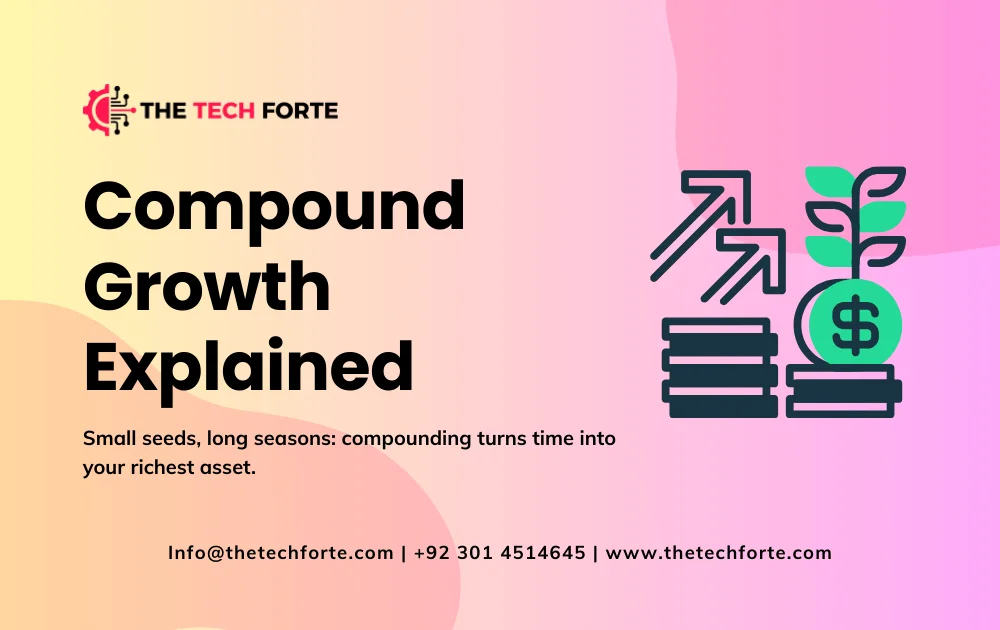
Compound Growth Explained: How Compounding Builds Wealth Over Time

Compound growth is the single most powerful, provable force in long-term personal finance. Put simply, compounding is “interest on interest,” the process where investment gains are reinvested so that future returns are earned on prior returns as well as the original capital. Over years and decades, this produces exponential growth: modest recurring savings become material wealth.
This article is a deep, practical, expert-level explanation of compounding for anyone who wants to understand not just the concept but how to use it: the math, the real-world examples, the traps (fees, taxes, inflation), and clear steps you can implement today to turbo-charge your long-term returns.
Suggested Read: How to Build an Investment Portfolio: Beginner’s Step-by-Step Guide
What is compounding? A precise definition
Compounding (or compound interest) is the process by which investment returns are reinvested so that future returns are calculated on the new (larger) principal. The result is not linear growth but exponential growth. The portfolio grows faster as it gets bigger because each period’s gains add to the base that earns future gains.
Contrast this with simple interest, where interest is calculated only on the original principal and never on the accumulated interest.
The compound interest formula (and variants)
There are three common forms you’ll see:
A. Discrete periodic compounding
If interest is added n times per year, annual nominal rate r, time in years t, and the initial principal P:Future Value (FV)=P×(1+nr)nt
Special cases:
n = 1→ annual compounding: FV=P(1+r)tn = 12→ monthly compoundingn \to \infty→ continuous compounding
B. Continuous compounding
When compounding is continuous (mathematical ideal): FV=P×ert
where e is the base of the natural logarithm.
C. Regular contributions (future value of an annuity)
If you add a fixed payment PMT each period (for example, monthly contributions), and the periodic rate i = r/n, over N = n*t periods:FV=PMT×i(1+i)N−1
This is the formula for a regular savings plan or SIP (Systematic Investment Plan). It shows why regular contributions compounded over time add huge value.
Key compounding examples: numbers that make the point
Concrete examples make the exponential effect obvious. (All numbers below are exact mathematical results computed precisely.)
Example 1: $1,000 at 7% for 30 years (annual)
Using FV=1000×(1+0.07)30:
- FV≈$7,612.26.
So a single $1,000 invested for 30 years at 7% grows to about $7.6k.
Example 2: $200 per month for 30 years at 7% (monthly contributions)
Using the annuity formula with monthly contributions:
- Monthly rate i=0.07/12.
- After 30 years, the future value is approximately $243,994.20.
That is: consistently saving just $200 every month for 30 years at a 7% annual return produces nearly $244k. This shows regular small contributions matter.
Example 3: Start early vs start later (same monthly contribution)
Two people each contribute $200 per month at 7%:
- Person A invests $200/month for 10 years beginning at age 25, then stops contributing and leaves money invested until age 65. Result at 65: $263,513.14.
- Person B starts at age 35 and invests the same $200/month for 30 years (age 35–65). Result at 65: $243,994.20.
Even though both invested the same monthly amount and the same total dollars contributed, Person A, who only contributed for 10 years early ends up more wealthy. That is the power of compounding and starting early.
Example 4: Fees matter (effect on $10,000 over 30 years)
Assume a nominal gross return of 7%:
- $10,000 at 7% for 30 years → $76,122.55 (gross).
- If the fund charges a tiny 0.05% annual fee (net return = 6.995%), the final value ≈ $75,062.61.
- If the fund charges a 1.00% annual fee (net return = 6.00%), the final value ≈ $57,434.91.
A 0.95 percentage point higher fee reduces final wealth from ~$76k to ~$57k, a loss of nearly $19k on $10k initial investment over 30 years. Fees compound, too; they are a tax on compounding. Choose low fees.
Why time matters: the exponential effect
Compounding is exponential: small increases in rate or time yield large differences in outcomes.
- Doubling time rule (approximate): Doubling time≈r% 72. At 7% annual, money roughly doubles every ~10.3 years.
- The final decades matter most: on a long horizon, the later years produce the largest absolute gains because the base is much larger (think of a snowball that becomes an avalanche).
That’s why starting a decade earlier makes such a difference. Early contributions have many more compounding periods.
Reinvestment: dividends, interest, and distributions
Compounding works only if returns are reinvested. Reinvestment can take many forms:
- DRIP (Dividend Reinvestment Plans): dividends are used to buy more shares automatically, making dividend-paying stocks and funds.
- Bond coupon reinvestment: coupon payments are used to buy additional bonds or funds.
- Mutual fund distributions: automatic reinvestment multiplies growth as distributions buy additional fund units.
If you choose to take distributions in cash rather than reinvesting, you interrupt compounding. For growth accumulation, reinvesting is usually optimal (tax implications aside).
How compounding interacts with contributions (annuity math)
Two levers matter for accumulated wealth:
- An initial principal (P), a bigger starting balance, helps.
- Contributions (PMT) regular contributions dramatically increase FV because each contribution compounds from the deposit time to the horizon.
For a fixed return, increasing monthly contributions or starting earlier usually produces more impact than marginally higher short-term returns. The annuity formula from Section 2 demonstrates this.
Practical takeaway: If you can’t save a large lump sum, a small recurring contribution sustained over decades creates large wealth via compounding.
Fees, taxes, and inflation: how they erode compounding
Compounding can be undermined by three real-world factors: fees, taxes, and inflation. Each reduces the net rate that compounds.
Fees
Even modest fees compound against you. As shown earlier, a 1% higher fee over 30 years dramatically lowers final wealth. Prefer low-cost index funds/ETFs for your core holdings.
Taxes
Taxes on dividends, interest, and capital gains reduce the actual return that compounds in your account. Use tax-advantaged accounts (IRAs, 401(k)s, or local equivalents) when possible; they shelter compounding from annual tax leaks.
Inflation
Nominal returns must be viewed in real terms. If your portfolio returns 7% nominal and inflation is 3%, the real return ≈ (1.07/1.03 − 1) ≈ is 3.88% per year. Over decades, inflation significantly reduces purchasing power, and compounding on nominal returns may overstate true wealth increases. Always think in real (inflation-adjusted) terms for long-term goals.
Practical rules to maximize compounding power
These are actionable, ranked by impact.
1) Start early; time is the multiplier
The earlier you start, the more compounding periods your money has. Even small amounts saved young outperform much larger late starts.
2) Save regularly (SIP / DCA)
Automate monthly contributions. Dollar-cost averaging smooths purchase prices and builds habit.
3) Keep costs low
Choose low-expense-ratio funds for core holdings. Fees compound against you.
4) Reinvest distributions
Use dividend reinvestment plans or automatic reinvestment in funds to keep returns compounding.
5) Use tax-advantaged accounts
Shelter compounding in retirement accounts or tax-efficient vehicles where available.
6) Stay invested, avoid market timing
Missing the best market days can significantly lower long-term returns. Compounding rewards time-in-market, not timing.
7) Diversify and match risk to horizon
Keep an asset allocation that suits your time horizon. Don’t put short-term funds into volatile assets where sequence of returns risk can harm withdrawals.
8) Avoid unnecessary portfolio churn
Frequent trading raises transaction costs and taxes, which reduce compounding.
9) Monitor but don’t micro-manage
Check allocations and rebalance when drift occurs, but don’t react to every headline.
10) Increase contributions over time
Raise contributions when income rises, the marginal extra savings compound and can substantially improve outcomes.
Compounding and risk: matching investment to horizon
Compounding is most useful when you can stay invested through volatility.
- Short horizon goals (0–3 years): prioritize capital preservation; compounding on safe instruments (high-quality bonds, money market funds) is modest but secure.
- Medium horizon (3–10 years): balanced allocation; a mix of bonds + equities can compound while limiting large drawdowns.
- Long horizon (10+ years): higher equity allocation captures compounding of growth with historically higher expected returns.
Sequence of returns risk: For retirees who are withdrawing, early negative returns can dramatically reduce sustainable withdrawals because losses early in the withdrawal phase lock in lower capital managed by holding a liquid short-term bucket.
Common myths and realities about compounding
Myth: Compounding is only for the rich
Reality: Compounding benefits any saver. Consistent small contributions beat occasional big sums starting late.
Myth: You must beat the market to compound effectively
Reality: You only need a reasonable, sustainable return after fees and taxes. Long-term index returns historically beat most active strategies after costs.
Myth: Higher returns always trump contributions and time
Reality: A slightly higher return can’t always beat starting earlier or saving regularly. Time and contributions are often more powerful levers.
Practical tools: calculators, benchmarks, and checklists
Quick calculators to use
- Future value of lump sum: FV=P(1+r)t
- Future value of monthly contributions: FV=PMT×i(1+i)N−1 where i=r/12 and N=12t.
Use online compound interest calculators (or a spreadsheet) and always test several scenarios.
Simple checklist before investing
- Have a 3-6 months emergency fund?
- Are your goals and horizons defined?
- Are you maximizing tax-advantaged accounts?
- Are fees low and distributions reinvested?
- Is your allocation aligned with horizon and risk tolerance?
- Are contributions automated?
Example roadmaps for typical goals
Retirement starter (age 30, retirement at 65)
- Automated monthly contributions into diversified equity index funds + target date funds for glidepath.
- Maximize retirement account contributions to benefit from tax sheltering.
- Rebalance annually.
House deposit (5-year horizon)
- Use conservative allocation: a short-duration bond ladder + cash to avoid principal risk. Compounding is limited, but preservation is primary.
College savings (15 years)
- Use a 60/40 equity/bond mix early, shift to more bonds as the horizon shortens. Use tax-advantaged education accounts if available.
How to teach compounding to others (kids, colleagues)
Simple experiments work best:
- Show the difference between $100 invested at 7% for 40 years vs $100 at 3% the gap is large.
- Run the early start vs late start monthly contribution example to show that starting earlier matters more.
- Use visual charts (log scale) to show exponential curves.
Putting it all together: a 5-step personal compounding plan
- Define goals & horizon. Write them down and date them.
- Automate contributions (set up SIP/payroll investment).
- Choose low-cost diversified core holdings (broad index funds or target-date funds).
- Reinvest all distributions and keep investments in tax-advantaged accounts first.
- Review annually: rebalance, increase contributions, and avoid fees and taxes.
Final perspective of Compound Growth: compounding is boring but powerful
Compounding is not a get-rich-quick scheme. It’s slow, methodical, and mercilessly effective if you obey its rules: start early, contribute regularly, keep costs low, reinvest, and stay invested through volatility. Most wealth in retirement accounts is created in the last decades, but that outcome is only possible because of consistent compounding earlier in life.
Last thought: The best time to plant a compounding “seed” was yesterday. The second-best time is now. Start the plan with a small amount today and let time be your most powerful ally; work the rest.