IoT Innovations in 2026: How Smart Devices Are Transforming Daily Life

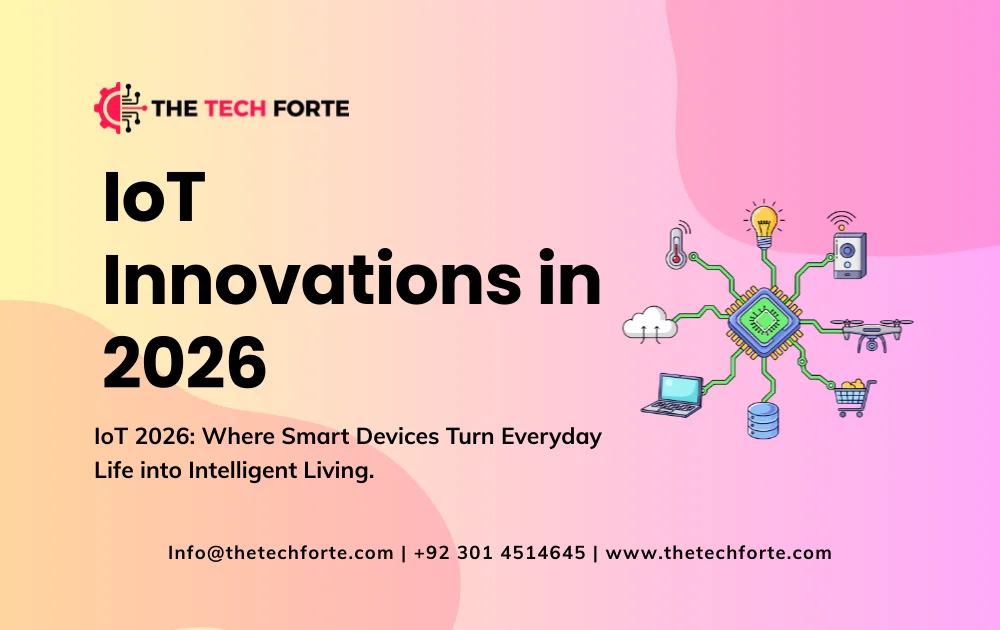
The Internet of Things (IoT Innovations) in 2026 is no longer an experimental novelty; it’s an embedded fabric of modern life. From IoT sensors that monitor air quality in smart cities to wearable IoT devices that feed clinicians near–real-time patient telemetry, smart devices are reshaping how we live, work, and govern built environments. This article explains the breakthrough sensor technology for smart devices, how artificial intelligence in smart devices (AIoT) is changing decision-making at the edge, where smart devices in hospitals are having a measurable impact, what the best smart devices for home delivery today are, and which future applications of smart devices are likely to reach mainstream adoption next.
Throughout, I use industry evidence and trend analysis to explain not just “what” is new in IoT technology 2026, but why it matters and how organizations and individuals can capture value while managing risk.
Suggested Read: Ambient Intelligence: The Future of Smart Living in 2026
What changed in IoT by 2026: an overview
Three structural shifts define IoT in 2026:
- From telemetry to autonomy. Devices are no longer mere data sources. Local inference and actuation (edge AI) allow real-time control loops for traffic lights, factory motors, or medical alarms rather than waiting for cloud processing.
- Sensor renaissance. Advances in MEMS, photonics, and low-power analog front-ends mean sensors measure more modalities (chemical, acoustic, particulate, physiological) with improved accuracy and lower cost. This opens new applications in environmental monitoring and personalized health.
- Connectivity diversity. The connectivity layer is heterogeneous: private 5G for industrial campuses, LPWAN (NB-IoT, LoRaWAN) for low-power wide-area sensing, Wi-Fi 6/7 and Thread/Matter for home automation, and satellite IoT for remote coverage. This mosaic is essential for scaling IoT globally.
These shifts together create an IoT ecosystem that is real-time, inexpensive to scale, and actionable with consequences across sectors.
Sensor technology for smart devices: what’s new
The practical reach of IoT depends on sensors. In 2026, the sensor landscape advanced in three major ways:
Multimodal, miniaturized sensors
Modern IoT sensors combine modalities (e.g., temperature + humidity + VOC + particulate) in a single package. That multimodal approach improves context-awareness and reduces deployment costs. MEMS breakthroughs and integrated photonic sensors enable detection of gases and particulates at ppb/µg levels in compact modules. These sensors are small and affordable enough to be embedded in street furniture, HVAC ducts, and handheld wearables.
Ultra-low-power sensing
Battery life remains critical. Energy-optimized sensing and intermittent wake strategies, paired with energy-harvesting options (solar, thermal) enable multi-year deployments of environmental sensors and asset trackers. LPWAN standards (NB-IoT, LoRaWAN) complement sensor improvements by providing low-power wide-area connectivity.
Intelligent sensing (sensor + edge AI)
Raw data is expensive; local intelligence reduces costs and time-to-action. New sensor nodes include micro-AI accelerators able to run anomaly detection, event classification, and local privacy-preserving aggregation. Instead of sending all data to the cloud, nodes transmit events, summaries, or model updates. This reduces bandwidth, latency, and privacy exposure.
Why it matters: richer, cheaper, and smarter sensors make large-scale deployments economically and technically feasible, from city-wide air-quality arrays to continuous patient monitoring.
Artificial intelligence in smart devices: the rise of AIoT
AI + IoT integration (AIoT) is the defining architectural pattern of 2026. There are three practical layers where AI operates:
Device-level AI (TinyML / edge inference)
TinyML models running on-device recognize patterns in sensor streams fall detection on wearables, anomaly detection in vibration patterns for predictive maintenance, or voice command classification in home devices. TinyML reduces latency and preserves privacy.
Edge-level orchestration
Edge servers aggregate node data, run heavier models (digital twins, predictive analytics), and provide local policy control. For example, a factory edge server synthesizes vibration, temperature, and power data across machines to predict failures hours before a fault occurs.
Cloud + federated learning
Cloud platforms provide long-term model training and cross-site learning. Federated learning methods allow model improvement without uploading raw personal data, an important privacy-preserving technique for health and consumer IoT.
Examples of AIoT in action:
- Smart traffic systems that learn signal timing to minimize congestion and emissions.
- Agricultural sensor networks that predict irrigation needs and optimize fertilizer use.
- Predictive maintenance in manufacturing that reduces downtime and spare parts inventory.
Connectivity foundations: private 5G, LPWAN, Wi-Fi & satellite IoT
No single connectivity standard dominates; rather, 2026’s networks are purpose-built:
- Private 5G provides ultra-reliable low-latency links for factories, ports, and hospitals where predictable service and mobility are required. It supports high device densities and edge integration for mission-critical control loops.
- LPWAN (NB-IoT, LoRaWAN) enables long-duration sensor deployments with tiny data payloads ideal for meters, environmental sensors, and asset trackers.
- Wi-Fi 6/7 and Matter/Thread standardize home automation and local area device interoperability, allowing the best smart devices for the home to work across brands with improved security.
- Satellite IoT (LEO) closes the coverage gap for maritime, remote agriculture, and logistics, enabling globally consistent telemetry.
Design principle: match the network to the use-case, not vice versa. This mix of connectivity technologies is the backbone of scalable IoT.
Smart devices in hospitals: IoMT transforming care
The Internet of Medical Things (IoMT) is one of the most impactful 2026 use cases. Hospitals deploy smart devices across care pathways:
Continuous patient monitoring (wearables + sensors)
Wearable IoT devices now monitor vital signs (ECG, SpO₂, respiratory rate), movement, and medication adherence with hospital-grade algorithms. They enable early identification of deterioration and reduce alarm fatigue via smarter, context-aware thresholds. Studies and vendor pilots show reduced ICU transfers and better bed utilization where continuous monitoring is adopted.
Asset tracking and workflow optimization
Smart tags and BLE/RTLS systems track equipment (ventilators, pumps), reducing search time and improving turnover. Integration with Electronic Health Records (EHRs) automates device assignment and maintenance scheduling.
Remote patient management & telehealth
Connected devices enable post-discharge monitoring, chronic disease management, and tele-rehab. Clinical models increasingly incorporate remote device telemetry into treatment decisions, expanding care beyond hospital walls.
Caveats & challenges: medical-grade validation, regulatory approvals, data governance, and workflow integration remain barriers. Hospitals typically pilot devices, demonstrate clinical value, and scale once evidence accumulates.
Best smart devices for the home in 2026: what to buy and why
Home IoT has matured: the best smart devices for the home in 2026 combine privacy, interoperability, and genuine utility.
Top categories and examples
- Smart thermostats & HVAC controllers deliver visible energy savings via adaptive scheduling and integration with utility demand-response programs. Local inference and edge rules reduce cloud dependence.
- Security & cameras with on-device analytics modern devices perform motion classification locally (person vs pet vs vehicle) to reduce false alarms and privacy exposure.
- Smart locks & access systems integrate with digital identity and short-lived credentials (e.g., eSIM-based guest access) for secure remote access.
- Voice assistants with local wake-word & NN inference process more commands locally for privacy; cloud for heavy tasks.
- Smart appliances (ovens, washers, fridges) provide predictive maintenance alerts, cycle optimization, and inventory suggestions via scanning and inventory tracking.
Buying guidance: pick devices that support open standards (Matter, Thread), offer robust local processing, provide clear firmware update policies, and integrate with your chosen hub or ecosystem. Security and privacy should be prioritized over gimmicks.
Future applications of smart devices: the next wave
Beyond current use, several future applications of smart devices are maturing toward wider adoption:
Digital twins at scale
Cities and enterprises are building digital twins, real-time virtual replicas that use IoT sensor feeds and AI to test scenarios (traffic re-routing, energy load balancing, disaster response). Digital twins close the loop between sensing and simulation.
Environmental & pollution monitoring
Dense sensor grids monitor air quality, particulates, and noise pollution to inform policy and personal behavior. Hyperlocal pollution alerts can help vulnerable populations avoid hotspots.
Predictive infrastructure maintenance
IoT sensors on bridges, rails, and grids detect early signs of wear; AI predicts when maintenance is needed, shifting spending from reactive repairs to optimized preventive work.
Autonomous logistics & coordinated fleets
Smart devices on vehicles and in the road/air infrastructure enable cooperative behaviors platooning, dynamic routing, and automated last-mile delivery, using real-time sensor fusion.
These applications are incremental now, but could combine into systemic shifts over the next 3–7 years.
Data, analytics & decision-making turning signals into action
Large-scale IoT is a data problem. In 2026, organizations deploy layered analytics:
- Real-time event detection at the edge (alerts, controls).
- Stream processing at the regional edge (aggregations, local ML models).
- Cross-site analytics in the cloud (trend analysis, model training, digital twins).
Solutions increasingly embrace explainable AI, model governance, and data catalogs to ensure models driving automated actions are auditable and trustworthy. This is essential for regulated domains (healthcare, utilities).
Security, privacy & governance non-negotiable constraints
As IoT scales, so do risks. Key 2026 priorities:
- Device security: secure boot, hardware root of trust, signed firmware updates, and vulnerability disclosure processes.
- Network security: zero-trust architectures, segmentation, and encrypted telemetry across LPWAN and private 5G.
- Data privacy: local processing, anonymization, and consent-driven data sharing (e.g., federated learning for health).
- Regulatory compliance: medical devices, critical infrastructure, and consumer privacy laws require specific certification and operational controls.
Security and governance are not add-ons; they are critical design pillars.
Business models & economic impact
IoT in 2026 is monetized through diverse models:
- SaaS + device: devices sold or subsidized, with recurring platform subscriptions (analytics, alerts, digital twin access).
- Outcome-based pricing: infrastructure and industrial clients pay for uptime, energy savings, or reduced downtime rather than hardware.
- Data co-ops & marketplaces: anonymized city or environmental data is monetized for research and planning while respecting privacy.
Economic benefits include operational savings, new revenue streams (services), and societal gains (reduced pollution, better health outcomes).
Challenges & what must improve
Despite progress, adoption faces hurdles:
- Interoperability fragmentation. Although Matter and other standards are improving home device compatibility, industrial and city ecosystems still suffer from platform silos.
- Standards and certification. Medical and industrial deployments require rigorous testing and certification, a slow and expensive process.
- Skill gap. Designing, deploying, and operating AIoT systems needs cross-disciplinary talent (embedded systems, data science, cybersecurity).
- Sustainability & e-waste. Large sensor rollouts must plan for device lifecycle, repairability, and recycling.
Addressing these will determine whether the next wave of IoT becomes ubiquitous and equitable.
Case studies: real deployments in 2026
Case study: A Smart city air-quality network
A mid-sized European city deployed dense particulate and VOC sensors with local edge aggregation and a citizen-facing alert app. The result: targeted traffic restrictions during high-pollution events and measurable reductions in exposure for vulnerable districts. The deployment used LPWAN for wide-area coverage and edge AI to filter false positives.
Case study: B Hospital remote-monitoring program
A tertiary hospital used wearable IoT devices for step-down monitoring of post-op patients. Continuous telemetry allowed early intervention for infections and reduced readmission rates. Federated learning enabled model improvement across partner hospitals without sharing raw patient data.
Case study C: Industrial predictive maintenance
A manufacturing plant integrated vibration sensors, thermal imaging, and motor telemetry into an edge analytics platform. Predictive models reduced unplanned downtime by 40% in the first year, improving throughput and reducing spare-part inventory.
Recommended Read: The Future of Healthcare: AI Doctors and Smart Hospitals
How organizations should approach IoT initiatives in 2026 practical roadmap
- Start with the problem, not the tech. Define the operational or customer outcome you want to change.
- Prototype at edge scale. Deploy a limited pilot with sensors and edge analytics; evaluate real-world noise and false positives.
- Design for privacy & security from day one. Use secure device onboarding, hardware roots of trust, and local processing where feasible.
- Plan for lifecycle & sustainability. Choose repairable devices and plan decommissioning/recycling.
- Use open standards and APIs. Avoid vendor lock-in; prioritize ecosystems that support Matter, Thread, or industrial standards.
- Measure outcomes, not just telemetry. Track business KPIs like downtime, energy usage, readmissions avoided, or response time improvements.
The near-future (2026–2028): what to expect next
- Wider adoption of AIoT in regulated sectors (healthcare, utilities) as federated learning and device validation mature.
- Satellite IoT scale-up as LEO constellations offer affordable telemetry for remote deployments.
- Greater standardization across device ecosystems and more commoditized digital twin platforms for small cities and mid-market enterprises.
Conclusion: Designing IoT Innovations for people and the planet
IoT innovations in 2026 have moved the needle from data collection to real-world, measurable action. Smart devices fueled by better sensor technology, edge AI, and flexible connectivity enable safer hospitals, more efficient cities, and homes that conserve energy and respect privacy. Yet the real success of IoT will be judged by how responsibly and inclusively we deploy it: secure by design, sustainable by lifecycle, and governed with transparency.
If you are planning an IoT initiative, prioritize outcomes, iterate with pilots, bake in security and privacy, and choose partners that commit to open standards and sustainability. The technology is ready; the ethical, operational, and governance work will determine whether this wave improves daily life for everyone.