Samsung Galaxy S25 Lineup: Full Features, Specs & Release Guide

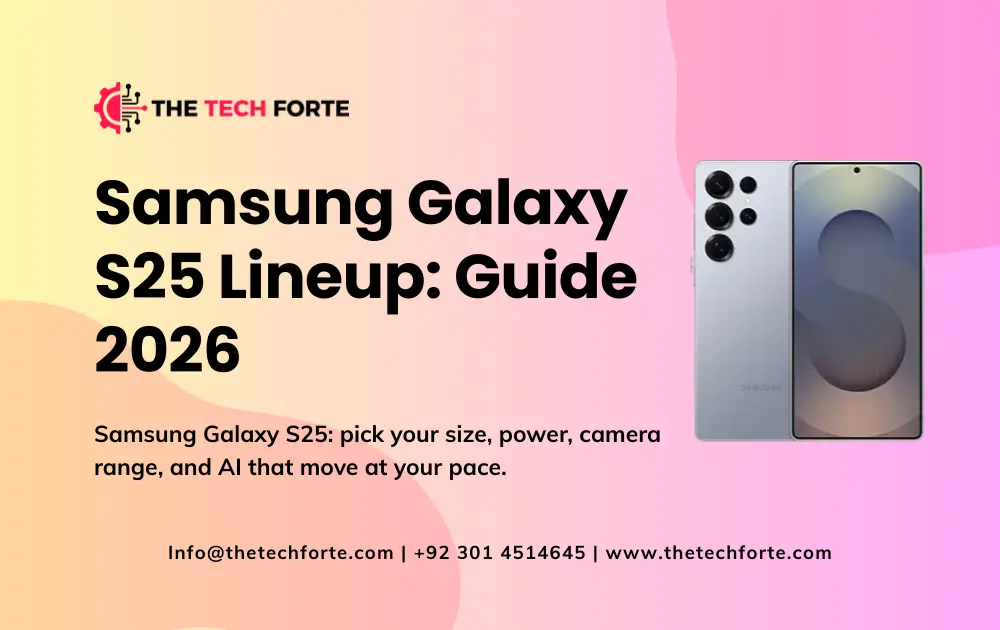
Samsung Galaxy S25 is designed as a three-tier flagship ladder, same core platform (performance, AI features, and long software support expectations) but with deliberate splits in display size, camera reach, and endurance so buyers can pay only for the upgrades they actually use. This guide breaks the lineup down like an engineer would (what’s inside and why it matters) and like a buyer should (what you gain per tier and when the premium is justified).
Suggested Read: Best Phones in 2026: 15 Top-Rated Smartphones Right Now
Release guide: when the Galaxy S25 series arrived (and what “release” means in practice)
Samsung positioned the Galaxy S25 series as its early-year flagship cycle: it was announced on January 22, 2025, at Samsung’s Unpacked event, and the company’s regional launch communications show retail availability beginning in mid-February 2025 (with pre-order windows opening immediately after the announcement).
For buyers, “release” usually translates into three practical moments:
- Announcement (what’s new): the spec and feature set are finalized and public.
- Pre-order (price/bonuses appear). This is when carrier bundles and trade-in deals typically lock in.
- Retail availability (real-world buying) is the point where inventory stabilizes, and comparison shopping becomes most reliable.
The lineup at a glance: Samsung Galaxy S25 vs Samsung Galaxy S25 Plus vs Galaxy S25 Ultra
At the highest level, the lineup splits into three “use profiles”:
- Samsung Galaxy S25 features (base): the compact flagship with the same core platform (Snapdragon 8 Elite for Galaxy) and a strong triple-camera set built for people who want top-tier performance without paying for the largest screen or the longest zoom range.
- Samsung Galaxy S25 Plus: the “big screen, bigger battery” step-upkeeping the same camera stack as the base phone while delivering more endurance and a roomier canvas.
- Galaxy S25 Ultra: the “creator-grade” tiermax display size, the most ambitious camera system (including a 200 MP main sensor and longer optical reach), and the broadest storage ceiling.
This structure is why the S25 family is unusually easy to map to real needs: if your bottleneck is screen size or battery life, you’re usually looking at the Samsung Galaxy S25 Plus; if your bottleneck is camera reach and pro video workflows, the Ultra is the rational upgrade.
Samsung Galaxy S25 performance: what “Snapdragon 8 Elite for Galaxy” actually buys you
Snapdragon 8 Elite for Galaxy: the performance foundation
Across the lineup, the defining performance statement is the Snapdragon 8 Elite for the Galaxy platform. TechRadar’s review frames this SoC upgrade as the standout spec, pointing to significantly elevated peak CPU clocks and improved overall throughputmeaning the phone is better at sustaining high-load tasks like gaming, heavy editing, and complex multi-app workflows.
Why this matters beyond benchmarks (the real “performance” story)
In daily use, “Samsung Galaxy S25 performance” shows up as:
- Fewer slowdowns during camera bursts and editing (because camera pipelines are compute-heavy, especially when stacking HDR + stabilization + multi-frame fusion).
- More consistent responsiveness under load (long gaming sessions, prolonged video capture, or big app switches).
- More headroom for AI-assisted features (smart capture, enhanced photo/video processing, and workflow automation) without the device feeling like it’s constantly caught “rebalancing” itself.
Tom’s Guide underscores this shift by characterizing the S25 as an “all-in AI bet” where the performance headroom supports new on-device intelligence and smoother day-to-day behavior.
Samsung Galaxy S25 display: Dynamic AMOLED 2X + 120 Hz adaptive refresh (and why it changes the feel of the phone)
Display sizes (the most immediate purchase decision)
The S25 lineup is intentionally spaced by size:
- 6.2-inch display (Samsung Galaxy S25) is the most pocket-friendly flagship size.
- 6.7-inch display (Galaxy S25 Plus), the “big screen for everything” option that improves media, reading, and split attention without jumping to the Ultra’s maximum footprint.
- 6.9-inch display (Galaxy S25 Ultra), the maximal canvas, optimized for long sessions, editing, and dense information layouts.
Dynamic AMOLED 2X display and 120 Hz adaptive refresh rate (what you actually feel)
Samsung positions the S25 series around Dynamic AMOLED 2X with a 120 Hz adaptive refresh rate, meaning the panel can ramp up for smooth interaction and drop down to save power when the screen is static. Samsung’s own buying guide materials call out the 6.7” QHD+ Dynamic AMOLED 2X experience (and the same technical family extends across the series).
In practical terms: scrolling feels “glassy” and responsive, animations look more natural, and the device can still preserve battery by lowering refresh, which is especially important when you’re not actively interacting with the screen.
Galaxy S25 display size differences: choosing the right ergonomic trade-off
The tightest decision is usually not “better vs worse” but comfort vs canvas:
- If you prioritize one-hand control, the 6.2-inch S25 is the most balanced “do everything” choice.
- If you multitask visually (docs + chat + video) or simply prefer a bigger workspace, the 6.7-inch S25 Plus is the sweet spot.
- If you treat the phone like a pocket workstation (editing, long reading sessions, or heavy media), the 6.9-inch Ultra is the most “desktop-like” phone in the lineup.
Camera systems explained: Samsung Galaxy S25 camera specs (and what they mean in the real world)
The baseline camera architecture: 50 MP main + ultra-wide + telephoto
Across the S25 and S25 Plus, the camera stack is built around a 50 MP main camera (wide) paired with a 12 MP ultra-wide camera and a 10 MP telephoto camera (3x optical zoom), a combination that covers most everyday scenarios: wide landscapes, normal framing, and a true optical step-in for portraits or distant subjects.
This is what makes the base models genuinely “flagship-grade”: they don’t rely on digital zoom as the primary solution, and the system is designed to give you clean results across common shooting situations.
Galaxy S25 Ultra: 200 MP main camera + expanded reach (and why it matters)
The Galaxy S25 Ultra changes the camera equation by moving to a 200 MP main camera and adding higher-end supporting lenses, including a 50 MP ultra-wide (S25 Ultra) and a 50 MP telephoto with 5× optical zoom (S25 Ultra).
This configuration is not just about “more megapixels,” it’s about more usable detail across more shooting distances (especially when you can’t physically move closer) and stronger flexibility for serious photography workflows (sports, wildlife, stage events, and travel scenes where framing options are limited).
Triple / Quad rear-camera system: the real distinction between tiers
A clean way to summarize the lineup is:
- Samsung Galaxy S25 / Galaxy S25 Plus: triple rear-camera system (wide + ultra-wide + 3× telephoto).
- Galaxy S25 Ultra: quad rear-camera system (expanded sensor mix to support the 200 MP main and longer optical reach).
This matters because “camera quality” is not one number; it’s the range of situations where the phone can capture a clean, detailed image without resorting to heavy digital zoom or aggressive processing.
Galaxy S25 Ultra camera review: where it wins (and where it’s overkill)
If you’re evaluating the Ultra specifically, the most meaningful wins tend to cluster around three use-cases:
- Long-range composition (5× optical zoom) without quality collapse. The 50 MP telephoto with 5× optical zoom (S25 Ultra) is designed to keep distant subjects sharp and usable, rather than turning them into soft, heavily interpolated images.
- High-detail “primary capture” the 200 MP main camera is aimed at extracting detail in complex scenes (texture, fine patterns, dense landscapes) where lower-resolution sensors can lose nuance.
- Pro-grade flexibility for creators’ major reviews positions the Ultra as a “superphone” specifically because it combines top-tier performance with a camera system meant to support serious creative work (not just casual snapshots).
At the same time, the Ultra’s premium is easiest to justify if you actually use the extra reach and the larger display frequently; if your photography is mostly social/close-range or you rarely need the long zoom, the upgrade can become “spec depth” rather than a daily benefit.
Galaxy S25 battery life: what the numbers mean (and how the Plus changes the story)
Battery capacities across the lineup (the core trade-off)
The battery sizing is one of the simplest but most impactful differentiators:
- Samsung Galaxy S25: 4,000 mAh (compact chassis, still built for full-day use).
- Galaxy S25 Plus: 4,900 mAh (the “endurance” step-upespecially meaningful for heavy media and navigation).
- Galaxy S25 Ultra: 5,000 mAh (paired with the largest screen and the most demanding camera workflows).
Galaxy S25 Plus battery life: why it’s often the smartest upgrade
If your daily pattern includes long streaming sessions, extended photo/video capture, or prolonged travel days, the Plus model’s larger battery is often the most practical “quality of life” upgrade because it reduces the number of moments where you’re forced to manage power (and those moments are exactly where friction and mistakes happen).
Galaxy S25 charging speed and battery specs: what fast charging really buys you
Charging is where specs translate directly into time saved:
- Wired charging is split across the lineup with 25W on the smaller tier and 45W on higher tiers (matching the expectation that larger batteries and higher-end models benefit from faster replenishment).
- Wireless charging is listed at 15W, which is particularly useful for “top-up” behaviorcharging opportunistically without cables during the day.
The practical takeaway: if you routinely drain the phone (heavy camera use, gaming, long travel), the combination of a bigger battery and faster wired charging is often more valuable than a marginal camera or display upgrade.
Galaxy S25 storage and RAM options: choosing capacity like a workload planner
RAM (12 GB) and why it matters
Across the flagship S25 family, 12 GB RAM is the key enabler for smooth multitasking and sustained performance when multiple heavy apps are active (camera + editor + cloud sync + messaging). TechRadar’s specs for the S25 (and by extension the shared platform positioning) list 12 GB RAM as the baseline for the series’ “do more at once” identity.
Storage options: 128 GB / 256 GB / 512 GB / 1 TB (on Pro-tier models)
Storage choice is where purchasing decisions most directly affect long-term satisfaction because high-resolution photos and video consume space, especially if you keep originals and don’t aggressively offload. TechRadar’s S25 spec summary (and supporting Samsung spec references) anchors the lineup with these capacity steps, and the Ultra tier extends the ceiling to 1 TB for the heaviest media workflows.
A practical rule: if you shoot frequently (especially video) and you prefer keeping local archives, choose the highest storage tier you can reasonably afford because “running out” is one of the most frustrating phone limitations.
Connectivity and durability: 5G + Wi-Fi 7 + Bluetooth + NFC, plus IP68 peace of mind
5G connectivity, Wi-Fi 7, Bluetooth, NFC (what these upgrades change)
The S25 lineup is built for sustained high-throughput use: 5G connectivity for mobile bandwidth, Wi-Fi 7 for better performance in dense networks, and standard modern conveniences like Bluetooth and NFC for accessories and tap-to-pay workflows.
IP68 dust/water resistance: the “everyday protection” that reduces accidental damage
Samsung’s own spec materials and product pages reinforce the IP68 rating as a baseline durability promise, useful not because it makes the phone indestructible, but because it reduces the damage risk from everyday exposure (rain, splashes, and dust).
Galaxy S25 vs S25 Ultra comparison (the decision that actually matters)
If you’re choosing between “standard” and “Ultra,” the real fork is not “which is better?” It’s which constraints are binding for you:
- Choose Galaxy S25 (or S25 Plus) if:
- You want flagship-class performance without paying for the biggest display and longest zoom,
- Your photography is mostly day-to-day (people, travel, events), where 3× optical is enough, and
- You value a lighter, more manageable device for daily carry.
Choose Galaxy S25 Ultra if:
- You regularly need 5× optical zoom and the broader camera spectrum (especially for distant subjects),
- You treat your phone as a primary creator tool (long-form video, frequent editing, great detail capture), or
- You prefer the biggest screen for work and media, and you’re comfortable paying for that combination of size + capability
This is also where the “value vs premium comparison (standard vs Pro)” becomes practical: the Ultra is a “pro tool” premium if your daily work doesn’t demand its extra reach and screen real estate, the base models often deliver 90–95% of the experience at a meaningfully lower cost.
Galaxy S25 Ultra vs competitors 2025: where it competes hardest (and why it stays relevant)
In the 2025 flagship field, the Ultra’s strongest competitive identity is not “more gimmicks” but a combination of top-tier performance (Snapdragon 8 Elite), a very capable camera system (including the 200 MP main sensor and extended optical zoom), and long-endurance hardwarea package reviewers describe as keeping it in the “superphone” conversation even when the year’s innovation curve is relatively incremental.
What this means for buyers is simple: if you want the most complete “do-it-all” Android flagship experience (especially for photography and long sessions), the S25 Ultra remains one of the clearest “no-compromise” options in its class.
Which Galaxy S25 model to buy (a practical buyer’s guide)
If you want the fastest decision path, match your main constraint to the model:
- You want the best compact flagship → Samsung Galaxy S25 (the best balance of power and portability on the same core platform).
- You want upgraded endurance without moving to the Ultra’s price tier → Galaxy S25 Plus (battery and screen size are the main “quality of life” upgrades).
- You want the most capable camera system and the biggest screen for creation → Galaxy S25 Ultra (200 MP main camera + 5× optical zoom + maximum storage ceiling).
Final takeaway: how to read the S25 lineup (so you buy the right one the first time)
The Galaxy S25 family is engineered around a clear hierarchy: same core performance engine (Snapdragon 8 Elite for Galaxy) across the range, then tiered upgrades in display size, battery capacity, andmost importantly, camera reach and flexibility. If your usage is “everyday flagship,” the base S25 (or S25 Plus for endurance) is the sweet spot; if your usage is “phone as camera + creator workstation,” the S25 Ultra earns its premium by turning long zoom and high-detail capture from a nice-to-have into a daily advantage.