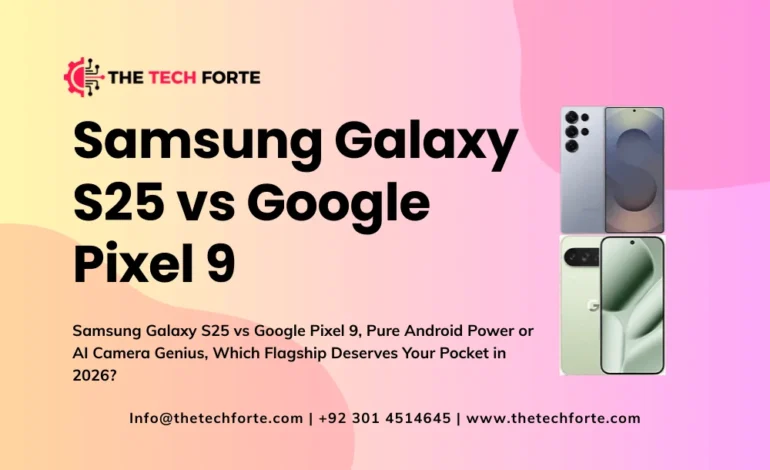
Samsung Galaxy S25 vs Google Pixel 9: Which Phone Wins

The Samsung Galaxy S25 and Google Pixel 9 are two of the most important compact Android flagships of 2026, and the broader Android flagships comparison extends to their bigger siblings: Samsung Galaxy S25 Edge, Samsung Galaxy S25 Ultra, Pixel 9 Pro, and Google Pixel 9 Pro XL. Together, these phones cover everything from compact vs larger screen designs to ultra‑premium camera powerhouses, all running Android 15.
If you are trying to decide which brand and which size deserves your money, you need to look closely at display tech, chipset performance, cameras, battery, software, and value proposition.
Below is an expert, in‑depth breakdown that uses all of Samsung’s and Google’s 2026 lineups as context, but keeps the focus on Samsung Galaxy S25 vs Google Pixel 9 as the core comparison.
Lineup Overview: Compact vs Larger Screen Flagships
Samsung and Google now mirror each other with a small/medium/large strategy.
Display Size (6.2″ / 6.3″ / 6.7″ / 6.8″)
Approximate sizes for the 2025–2026 cycle:
- Samsung Galaxy S25 – 6.2″
- Google Pixel 9 – 6.3″
- Samsung Galaxy S25 Edge – 6.7″ (slim, extra‑thin “Edge” design)
- Samsung Galaxy S25 Ultra – 6.8″
- Pixel 9 Pro – around 6.3–6.4″
- Google Pixel 9 Pro XL – 6.8″
So in the compact vs larger screen debate:
- True compacts: Samsung Galaxy S25, Google Pixel 9.
- Larger flagships: Samsung Galaxy S25 Edge, Pixel 9 Pro XL, and Samsung Galaxy S25 Ultra / Pixel 9 Pro as ultra‑premium big phones.
Ergonomics & Build Quality: Thin Form Factor vs Robust Design
- Galaxy S25: Slim and light, a true one‑handable phone with a thin form factor and minimalist camera rings; its 4,000 mAh cell keeps weight down.
- Pixel 9: Slightly thicker and heavier, with Google’s iconic camera bar/pill design; it feels more “robust” and substantial in the hand.
For larger models:
- Samsung Galaxy S25 Edge is extremely thin (about 5.8 mm thick), with a premium, ultra‑slim feel and surprisingly low weight (~163 g).
- Samsung Galaxy S25 Edge is extremely thin (about 5.8 mm thick), with a premium, ultra‑slim feel and surprisingly low weight (~163 g).
If you want the slimmest premium Android, the Samsung Galaxy S25 Edge wins; if you like a more solid robust design, the Google Pixel 9 Pro XL feels like a tank.
Ergonomics verdict:
- Small + light: Samsung Galaxy S25.
- Small but dense: Google Pixel 9.
- Big and thin: Samsung Galaxy S25 Edge.
- Big and solid: Google Pixel 9 Pro XL / Samsung Galaxy S25 Ultra.
Displays: AMOLED / OLED / LTPO Panels, 120 Hz & Brightness
All of these phones are strong on displays, but details matter if you care about size, panel type, and brightness.
Panel Types & Refresh Rate 120 Hz
Across the range:
- Samsung Galaxy S25 – 6.2″ AMOLED with 120 Hz refresh, likely LTPO (1–120 Hz) on the flagship line.
- Google Pixel 9 – 6.3″ OLED at 120 Hz, not LTPO on the base model.
- Samsung Galaxy S25 Edge – 6.7″ AMOLED or LTPO AMOLED at 120 Hz, QHD+ class resolution.
- Samsung Galaxy S25 Ultra – 6.8″ LTPO AMOLED at 1–120 Hz.
- Pixel 9 Pro – 120 Hz OLED (often LTPO on Pro tier).
- Google Pixel 9 Pro XL – 6.8″ LTPO OLED, QHD+ resolution, 1–120 Hz.
LTPO panels (S25 Edge, S25 Ultra, Pixel 9 Pro XL) can dynamically ramp down refresh rate to save battery when viewing static content, boosting endurance in day‑to‑day use.
Screen Brightness / Peak Nits & Resolution
Side‑by‑side specs for the big‑screen pair:
| Model | Size | Panel | Resolution | Peak Brightness |
|---|---|---|---|---|
| Google Pixel 9 Pro XL | 6.8″ LTPO OLED | QHD+ (1344 × 2992) | 3,000 nits peak | |
| Samsung Galaxy S25 Edge | 6.7″ LTPO AMOLED | QHD+ (1440 × 3120) | 2,600 nits peak |
The Google Pixel 9 Pro XL hits higher screen brightness/peak nits at 3,000, but the Samsung Galaxy S25 Edge still reaches a very high 2,600 nits and offers slightly higher pixel density (513 ppi vs 486 ppi).
The Google Pixel 9 Pro XL hits higher screen brightness / peak nits at 3,000, but the Samsung Galaxy S25 Edge still reaches a very high 2,600 nits and offers slightly higher pixel density (513 ppi vs 486 ppi):
Display verdict:
- Maximum brightness and outdoor legibility (especially at QHD+): Google Pixel 9 Pro XL.
- Best compact display in terms of brightness: Google Pixel 9 has the edge over Samsung Galaxy S25.
- Best combo of thin body + high‑resolution AMOLED: Samsung Galaxy S25 Edge.
Performance: Qualcomm Snapdragon 8 Elite Chip vs Google Tensor G4 Processor
Chipsets & Android Versions
- Samsung Galaxy S25 / S25 Edge / S25 Ultra
- All use the Qualcomm Snapdragon 8 Elite chip (a variant of Snapdragon 8 Gen 4) in most global markets.
- Run Android 15, One UI 7 with Samsung’s full suite of customization and Galaxy AI features.
- Google Pixel 9 / Pixel 9 Pro / Google Pixel 9 Pro XL
- All use the Google Tensor G4 processor, designed by Google with an emphasis on AI and camera pipelines.
- Run Android 15 with mostly stock UI and Google’s Pixel‑exclusive features.
- RAM Configurations (12 GB, 16 GB) & Storage
- Samsung Galaxy S25: typically 12 GB RAM, 128/256/512 GB storage (UFS 4.0 on higher capacities).
- Samsung Galaxy S25 Edge / S25 Ultra: 12 GB or 16 GB RAM on top tiers, 256/512 GB and 1 TB storage.
- Google Pixel 9: 12 GB RAM, 128/256 GB storage.
- Pixel 9 Pro / 9 Pro XL: 12 GB RAM (some rumors/higher trims at 16 GB), 256/512 GB and possibly 1 TB on Pro XL depending on region.
Samsung’s use of UFS 4.0 on high‑capacity models means faster app installs, game loads, and file transfers, and marginally better power efficiency than UFS 3.x.
Raw Performance & Benchmarks
In raw performance & benchmarks, Snapdragon 8 Elite generally outmuscles Tensor G4:
- CPU and GPU tests show Snapdragon 8 Elite scoring significantly higher than Tensor G4 in synthetic benchmarks (Geekbench, 3DMark), especially in GPU‑heavy loads like 3DMark Solar Bay or Wild Life Extreme.
- Tensor G4 is perfectly capable for everyday use, but it’s not chasing top‑of‑chart performance; it focuses on AI and camera pipelines.
Real‑world:
- On Samsung Galaxy S25, Samsung Galaxy S25 Edge, and especially Samsung Galaxy S25 Ultra, gaming at 120 Hz with max graphics is smoother and more stable than on Pixel 9 / Pixel 9 Pro XL.
- In the Pixel 9 series, high‑refresh gaming is still good, but Tensor G4 can throttle a bit earlier in long sessions.
Performance verdict:
- If you want the fastest Android phones for gaming, multitasking, and heavy workloads, the Qualcomm Snapdragon 8 Elite chip in the Samsung line wins clearly.
- If you care more about on‑device AI, smart features, and “good enough” speed, the Google Tensor G4 processor in the Pixel line is still very capable and power‑efficient for everyday tasks.
Cameras: Main Camera Megapixels, Lenses & Imaging Quality
The camera story changes dramatically between “base” models and their big siblings.
Main Camera Megapixels (50 MP / 200 MP) & Lens Setup
- Samsung Galaxy S25
- 50 MP main camera.
- Ultrawide and 3x telephoto lenses; solid triple camera system.
- Google Pixel 9
- 50 MP main camera.
- High‑resolution ultrawide (e.g., 48 MP) but no dedicated optical telephoto on the base model; relies on sensor crop for 2x–3x.
For the big dogs:
- Samsung Galaxy S25 Ultra
- 200 MP main camera with 12 MP default output.
- Ultrawide and telephoto lenses: 50 MP ultrawide, 10 MP 3x telephoto, 50 MP 5x telephoto.
- 4 rear cameras total, covering 0.6x to 10x+ effectively.
Pixel 9 Pro / Google Pixel 9 Pro XL
- 50 MP main camera (12 MP binned output).
- 48 MP ultrawide, 48 MP 5x telephoto on Pro tiers.
- 3 rear cameras total.
Imaging Quality & Processing
Independent camera comparisons show:
- Galaxy S25 vs Pixel 9 (base phones):
- Both deliver excellent stills in good light.
- Pixel 9 tends to win in imaging quality & processing for casual shooters: more natural colors, better HDR, and excellent low‑light software.
- Galaxy S25 images are sharper and more saturated, with more “Samsung‑style” punchy colors.
Samsung Galaxy S25 Ultra vs Pixel 9 Pro / Pixel 9 Pro XL:
- The 200 MP main camera on S25 Ultra can capture more detail than the Pixel’s 50 MP sensor, especially in fine textures; this is clear in crops and high‑zoom composite shots.
- S25 Ultra offers more zoom flexibility (3x and 5x optical) and generally sharper images at 5x and 10x than Pixel 9 Pro XL, even though Pixel 9 Pro XL has a high‑quality 5x telephoto.
- Pixel 9 Pro/Pro XL often output more “realistic” colors and smoother HDR; Samsung can be more contrasty and saturated.
Selfie Camera Specs
- Samsung Galaxy S25 Ultra selfie: ~12 MP.
- Pixel 9 Pro / Pixel 9 Pro XL selfie: 42 MP on Pro, binned to ~12.5 MP output, giving sharper details on paper.
- In practice, both produce excellent selfies; Google leans to more accurate tones, Samsung to slightly warmer ones.
Camera comparisons verdict:
- Base models (Galaxy S25 vs Google Pixel 9):
- Overall point‑and‑shoot stills (especially HDR, ultrawide, low light) → Pixel 9 slightly ahead.
- Versatility and telephoto options → Galaxy S25 (due to dedicated 3x).
- Premium models (Samsung Galaxy S25 Ultra vs Pixel 9 Pro / Google Pixel 9 Pro XL):
- Zoom reach, detail, and multi‑focal flexibility → Samsung Galaxy S25 Ultra.
- Natural color science and balanced processing → Pixel 9 Pro / Pixel 9 Pro XL.
Battery Capacity Differences & Charging Speeds
Battery Capacity Differences & Endurance Comparison
Battery sizes (approximate figures):
- Samsung Galaxy S25 – 4,000 mAh
- Google Pixel 9 – 4,700 mAh
- Samsung Galaxy S25 Edge – similar to 4,900 mAh range depending on exact spec.
- Samsung Galaxy S25 Ultra – 5,000 mAh
- Pixel 9 Pro / Google Pixel 9 Pro XL – ~5,000 mAh class (4,900–5,050 mAh depending on model).
Pure capacity favors the Pixel 9/Pro/Pro XL line, especially at the small end where Pixel 9 has 4,700 mAh vs S25’s 4,000 mAh.
However, endurance testing tells a more nuanced story:
- Tom’s Guide reports Samsung Galaxy S25 lasting 15h 43m in their browsing test, vs 13h 18m on Google Pixel 9, despite the smaller battery.
- AndroidCentral and AndroidHeadlines tests agree that Galaxy S25 and Pixel 9 offer very similar real‑world endurance, both comfortably lasting a full day of moderate use.
The difference comes from the Snapdragon 8 Elite’s efficiency and Samsung’s LTPO tuning.
Charging Speeds (25W / 37W, etc.)
Charging specs (base pair):
- Samsung Galaxy S25
- 25W wired.
- ~15W wireless (Qi2‑ready), plus 4.5W reverse wireless.
Google Pixel 9
- 27W wired.
- 15W wireless, Battery Share support.
In practice, charge times are close; the Pixel 9 cannot use its capacity advantage to fully outpace the S25 because of tuning and power curves.
Higher models (Edge, Ultra, Pro XL) vary by region, but you’ll typically see around 25–45W on Samsung and mid‑20s on Pixel Pro devices.
In practice, charge times are close; the Pixel 9 cannot use its capacity advantage to fully outpace the S25 because of tuning and power curves.
Higher models (Edge, Ultra, Pro XL) vary by region, but you’ll typically see around 25–45W on Samsung and mid‑20s on Pixel Pro devices.
Battery & charging verdict:
- Overall endurance comparison: Galaxy S25 and Pixel 9 are both all‑day phones; some lab tests favor Galaxy S25 despite smaller capacity.
- Capacity: Pixel 9 and Pro XL have bigger batteries on paper.
- Charging: Similar for base models; some Samsung models charge faster in upper tiers (Edge/Ultra) than Pixel Pro devices.
Software: Stock Android OS vs One UI, AI Features & Update Support
Stock Android OS vs One UI
- Google Pixel 9 / Pro / Pro XL
- Essentially stock Android OS with Google’s Pixel skin, clean, minimal, and free from duplicate apps.
- Quick access to new Android features and direct Google app integration.
- Samsung Galaxy S25 / Edge / Ultra
- Android 15, One UI 7 with heavy customization, a large feature set, and Samsung services alongside Google’s.
- You get more options (themes, layouts, multi‑window, DeX on Ultra) but also more settings to manage.
AI Features & Google Gemini
AI is a central pillar in 2026:
- Pixel 9 line
- Deep integration of AI features & Google Gemini, including smarter Assistant, call screening, auto‑summaries, and advanced photo tools (Magic Editor, object eraser, etc.).
- Tensor G4 is built to accelerate these workloads on device.
Samsung Galaxy S25 line
- Galaxy AI at the system level (live translation, summarize, generative edit) plus access to Google Gemini as a default assistant on many markets.
- Samsung adds its own AI layers, then leans on Google for core services.
Software Update Support
- Samsung Galaxy S25 family: up to 7 years of major OS and security updates, matching or closely mirroring Google’s policy for long-term support.
- Google Pixel 9 family: also targets 7 years of updates from launch.
Software verdict:
- Prefer clean, direct Google experience and the earliest Android features? Pixel 9 / Pixel 9 Pro / Google Pixel 9 Pro XL.
- Want richer customization, Samsung ecosystem, DeX, S Pen (Ultra), and Galaxy AI on top of Gemini? Samsung Galaxy S25 / Edge / Ultra.
Pricing Comparison, Value Proposition & Cost vs Features
Pricing Comparison
Exact prices vary by market, but general patterns:
- Base tier (Galaxy S25 vs Google Pixel 9):
- Very similar MSRP in the US and many markets; both target the ~$799 flagship range.
- In some regions, Pixel 9 may undercut the S25 slightly, or vice versa, depending on promotions and carrier deals.
- Mid/large tier (Samsung Galaxy S25 Edge vs Google Pixel 9 Pro XL):
- Both priced higher than base models, in the $999+ tier; S25 Edge may be slightly cheaper than the Pro XL in some markets.
- Ultra tier (Samsung Galaxy S25 Ultra vs Pixel 9 Pro):
- S25 Ultra generally sits at the top of Samsung’s pricing; Pixel 9 Pro is slightly cheaper than an Ultra in most regions.
Value Proposition: Cost vs Features
Base comparison (Galaxy S25 vs Pixel 9):
- Samsung Galaxy S25 gives you:
- Snapdragon 8 Elite performance.
- AMOLED with LTPO potential, 120 Hz.
- Telephoto camera, strong battery life, and One UI 7 features.
- Slight edge in endurance vs Pixel 9 in some tests.
- Google Pixel 9 gives you:
- Slightly larger 6.3″ screen with higher peak brightness.
- Bigger 4,700 mAh battery.
- Best‑in‑class still imaging quality and HDR, especially from ultrawide and main camera.
- Clean stock Android and deep Google AI integration.
At equal price, S25 is better for performance, flexible zoom, and some battery metrics; Pixel 9 is better for camera quality and display brightness.
Big phones (Samsung Galaxy S25 Edge / Ultra vs Pixel 9 Pro / Google Pixel 9 Pro XL):
- Samsung Galaxy S25 Edge: best if you want a slim, premium large phone with QHD+ and 2,600‑nit AMOLED; strong performance and multi‑camera setup.
- Google Pixel 9 Pro XL: best if you want a 6.8″ QHD+ LTPO OLED at 3,000 nits, Pixel‑level cameras, and clean Android, even though it’s thicker and heavier.
- Samsung Galaxy S25 Ultra: best if you want ultimate zoom, a 200 MP main camera, S Pen, and the most complete feature set for power users.
- Pixel 9 Pro: a balanced option that retains a great 50 MP main camera and 5x telephoto, but is smaller and cheaper than Ultra/Pro XL tier.
Value verdict:
- Best cost vs features for compact users:
- Performance‑focused → Samsung Galaxy S25.
- Camera/display‑focused → Google Pixel 9.
- Best big‑screen value:
- Slim, premium hardware → Samsung Galaxy S25 Edge.
- Camera and brightness‑first → Google Pixel 9 Pro XL.
- Ultimate all‑rounder (price no object): Samsung Galaxy S25 Ultra for sheer hardware, or Pixel 9 Pro XL if your top priority is camera output and display brightness
Everyday Experience: UI Fluidity & Day‑to‑Day Performance
In daily use:
- All phones feel extremely smooth thanks to 120 Hz displays and high‑end chipsets.
- UI fluidity is excellent on both One UI 7 and stock Android 15; differences are mainly aesthetic and feature‑level.
- Performance in everyday tasks such as messaging, social media, browsing, and casual gaming is effectively indistinguishable between Galaxy S25 and Pixel 9; only heavy gaming or pro workflows truly reveal Snapdragon vs Tensor differences.
Practical takeaway: if you’re a typical user, both phones will feel fast and fluid; your decision should lean more on design, display, camera style, and software preference than on raw benchmarks.
Final Verdict: Which Phone (and Lineup) Wins?
If we narrow the field to the core comparison, Samsung Galaxy S25 vs Google Pixel 9, and then consider the broader Android flagships comparison across Samsung Galaxy S25 Edge, Samsung Galaxy S25 Ultra, Pixel 9 Pro, and Google Pixel 9 Pro XL, the answer is:
- Choose Samsung Galaxy S25 if you want:
- A true compact flagship with a 6.2″ AMOLED display and thin body.
- The power of the Qualcomm Snapdragon 8 Elite chip with superior gaming and benchmark performance.
- A telephoto lens on the base model and slightly better endurance in some tests despite a smaller battery.
- One UI 7’s rich features and customization.
- Choose Google Pixel 9 if you want:
- A slightly larger 6.3″ OLED with higher screen brightness / peak nits and great outdoor legibility.
- A bigger battery (4,700 mAh) and Google’s best‑in‑class imaging quality for casual photography.
- Stock Android OS vs One UI preference, with immediate access to Google’s latest AI and Gemini features.
For big‑phone buyers:
- Samsung Galaxy S25 Edge → best for slim, premium large phone fans.
- Samsung Galaxy S25 Ultra → best for power users and camera hobbyists (200 MP, insane zoom, S Pen).
- Pixel 9 Pro → a balanced Pro without going giant.
- Google Pixel 9 Pro XL → best for display brightness and Pixel‑style Pro photography at 6.8″.
Overall, Samsung’s S25 lineup wins on raw performance, zoom versatility, and feature density, while Google’s Pixel 9 family wins on camera processing, screen brightness, and pure Android experience. The “better phone” is the one that aligns with your priorities: power and features → Galaxy, photos and simplicity → Pixel.