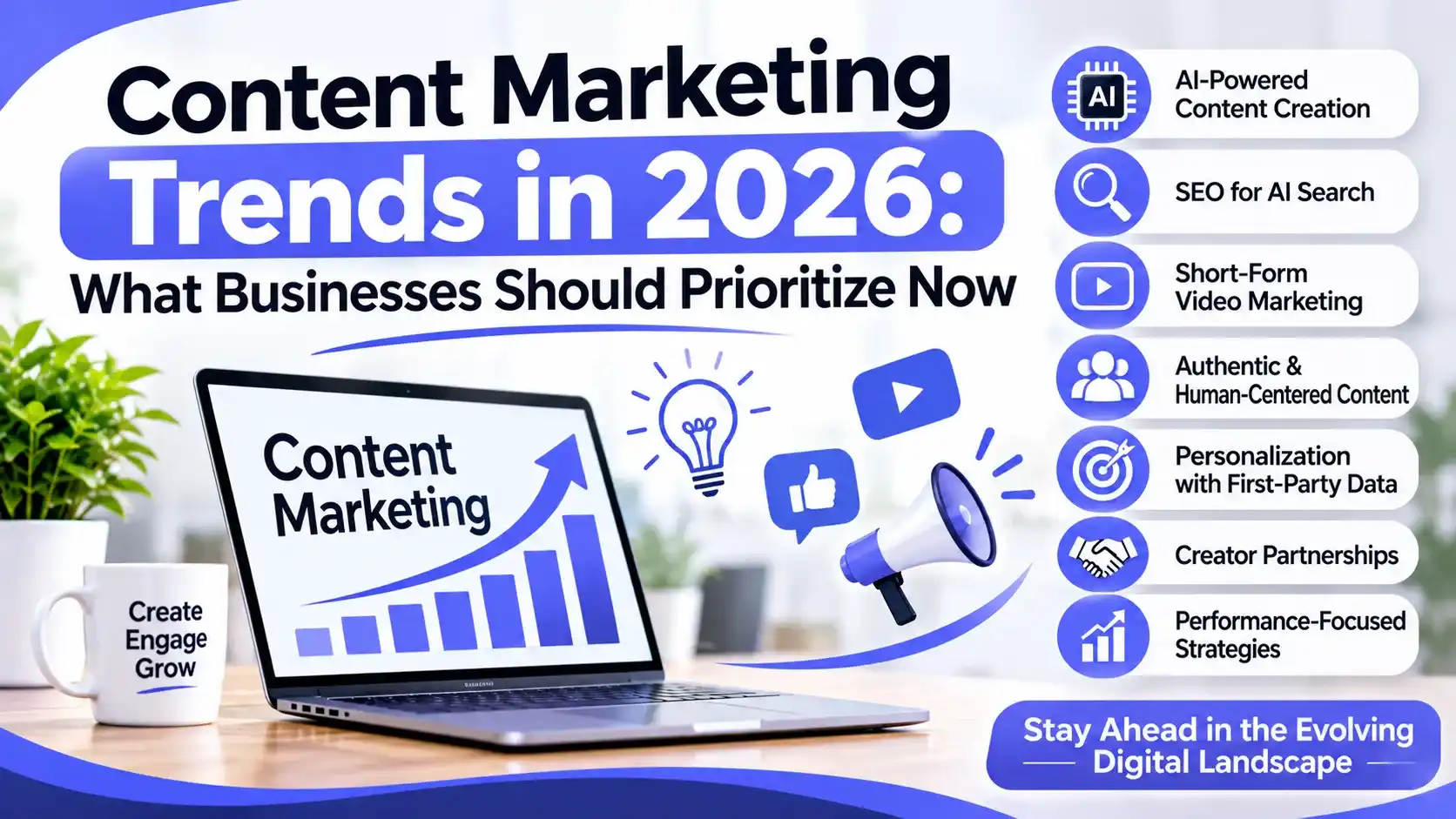
Introduction
Content marketing continues to evolve as artificial intelligence, changing search behavior, social media platforms, and customer expectations reshape the digital landscape. Businesses can no longer depend on publishing regular blog posts or promotional social media updates to attract attention. They need a more strategic approach that combines valuable information, creative storytelling, audience engagement, and measurable business outcomes.
In 2026, the biggest change in content marketing is not simply the growing use of artificial intelligence. It is the shift toward creating content that is more relevant, trustworthy, personalized, and useful across multiple digital platforms.
Customers increasingly discover brands through Google Search, AI-powered search experiences, YouTube, Instagram, TikTok, LinkedIn, and online communities. Each platform has different audience expectations, so businesses should develop content that matches how people consume information.
At the same time, AI tools are helping marketing teams research topics, generate ideas, analyze audience behavior, and automate repetitive tasks. However, businesses must maintain human creativity, brand identity, and factual accuracy to produce content that stands out in an increasingly competitive environment.
Understanding the latest content marketing trends in 2026 can help businesses make better marketing decisions, improve brand visibility, attract qualified audiences, and build stronger customer relationships.
This article explores the most important content marketing trends businesses should prioritize now and provides practical strategies for implementing them.
Recommended read: Common Google AdSense Approval Mistakes to Avoid
What Is Content Marketing in 2026?
Content marketing is a strategic approach to attracting, engaging, and retaining customers by creating and distributing valuable, relevant, and consistent content.
Traditional content marketing primarily focused on blog articles, website pages, email newsletters, and social media posts. Although these formats remain important, modern content marketing includes a much broader range of digital experiences.
Businesses now use:
- Search-engine-optimized blog articles.
- AI-assisted educational content.
- Short-form videos and reels.
- YouTube tutorials and product demonstrations.
- Podcasts and expert interviews.
- Infographics and visual storytelling.
- Email newsletters and automated campaigns.
- User-generated content and customer testimonials.
- Interactive tools, quizzes, and calculators.
- Community discussions and live sessions.
The objective is to deliver the right information through the right channel at the right stage of the customer journey.
In 2026, successful content marketing is less about publishing the most content and more about creating meaningful experiences that build trust and encourage customer engagement.
Why Content Marketing Is Changing in 2026
Several developments are influencing how businesses plan, produce, and distribute content.
1. Artificial Intelligence Is Transforming Content Production
AI tools have become an important part of modern marketing workflows. Businesses use them to research topics, develop content outlines, generate ideas, summarize information, analyze performance, and assist with content production.
However, the increasing availability of AI-generated material has also created more competition for audience attention.
Businesses must differentiate their content through original insights, practical experience, expert opinions, and accurate information.
2. Search Behavior Is Becoming More Conversational
Customers are no longer relying exclusively on traditional keyword-based searches.
AI-powered search experiences allow users to ask detailed questions and receive summarized answers. This is changing how people discover information and interact with websites.
Businesses must consider both traditional SEO and visibility across AI-powered search experiences.
3. Video Content Is Becoming More Important
Short-form videos, product demonstrations, tutorials, and educational videos are important content formats across social media platforms.
Customers often prefer seeing how a product works rather than reading a lengthy product description.
Brands are therefore investing in video content to improve awareness, engagement, and product discovery.
4. Customers Expect More Personalized Experiences
Generic promotional messages are becoming less effective in competitive markets.
Customers expect relevant recommendations, useful information, and communication that reflects their interests.
First-party data, customer segmentation, and marketing automation help businesses deliver more personalized experiences.
5. Brand Trust and Authenticity Matter More
As AI-generated content becomes increasingly common, businesses need to demonstrate credibility and authenticity.
Original research, customer experiences, expert contributions, transparent communication, and real-world examples can help brands establish stronger relationships with their audiences.
Top Content Marketing Trends in 2026
1. AI-Powered Content Creation With Human Oversight
Artificial intelligence is one of the most influential developments in content marketing in 2026.
Marketing teams are using AI tools to accelerate research, generate content ideas, create outlines, summarize reports, and support different stages of production.
According to HubSpot's 2026 State of Marketing report, 48.57% of surveyed marketers identified using AI to create personalized content as a leading marketing trend. Automation was another major priority, identified by 47.38% of respondents.
These findings demonstrate how AI is becoming integrated into everyday marketing activities.
However, AI-generated content should not automatically be considered publication-ready.
Businesses should use human review to ensure that content is accurate, relevant, engaging, and consistent with their brand voice.
How businesses should adapt:
- Use AI for topic research and brainstorming.
- Generate initial content outlines.
- Identify frequently asked customer questions.
- Improve content organization and readability.
- Assist with keyword research and content optimization.
- Review AI-generated information for accuracy.
- Add original insights and expert perspectives.
- Maintain a consistent brand voice.
The best approach is to combine AI efficiency with human creativity rather than relying entirely on automated content production.
2. SEO Is Expanding Into AI Search Optimization
Search engine optimization remains an important part of content marketing, but the way people discover information is changing.
Google AI Overviews, AI Mode, and other AI-powered search experiences can provide summarized answers to user questions.
This creates new opportunities and challenges for businesses that depend on organic search traffic.
Content teams should now consider how their websites can become useful, credible sources of information across both traditional search results and AI-powered discovery experiences.
This is often discussed through terms such as Answer Engine Optimization (AEO) and Generative Engine Optimization (GEO).
Businesses should prioritize:
- Publishing accurate and informative content.
- Answering specific customer questions.
- Using clear headings and logical content structures.
- Including original research and practical examples.
- Strengthening topical authority.
- Improving internal linking.
- Maintaining technically accessible websites.
- Keeping important content updated.
- Providing clear information about authors and expertise.
There is no guaranteed formula for appearing in AI-generated answers. Strong technical SEO, useful content, credibility, and clear information remain important foundations.
The objective should be to build visibility wherever potential customers search for information, not simply to chase individual search features.
3. Short-Form Video Marketing Continues to Grow
Short-form video remains a powerful format for attracting attention and communicating information quickly.
Platforms such as Instagram Reels, TikTok, YouTube Shorts, and Facebook Reels allow businesses to introduce products, explain services, share educational information, and connect with potential customers.
For example, a clothing brand can publish short styling videos, fabric demonstrations, collection previews, and customer experiences.
A digital marketing agency can create short videos explaining SEO mistakes, advertising strategies, website improvements, and marketing tips.
Content ideas businesses should prioritize:
- Quick educational tutorials.
- Product demonstrations.
- Behind-the-scenes videos.
- Customer testimonials.
- Frequently asked questions.
- Industry news and explanations.
- Before-and-after demonstrations.
- Short expert interviews.
Businesses should focus on strong opening hooks, clear messages, readable captions, and platform-appropriate video formats.
Instead of producing videos simply to follow a trend, brands should connect every video to a specific marketing objective.
4. Authentic and Human-Centered Content Is Gaining Importance
The growing volume of AI-generated material is increasing the importance of content that demonstrates genuine human experience.
Customers want to understand the people, expertise, and values behind a business.
According to Sprout Social's 2026 Social Media Content Strategy Report, consumers identified human-generated content as their top priority for brands on social media.
This suggests that businesses should not allow automation to remove the human element from their communication.
Human-centered content can include:
- Employee stories.
- Founder experiences.
- Expert opinions.
- Customer success stories.
- Behind-the-scenes content.
- Real product demonstrations.
- Industry experiences.
- Honest product comparisons.
For example, a software company could publish an article explaining a technical problem its development team solved for a client.
A fashion brand could share the creative process behind a collection, highlighting craftsmanship, design decisions, and the people involved.
Such content gives audiences a more meaningful reason to connect with a brand.
5. Personalized Content Marketing Using First-Party Data
Personalization is becoming an important part of effective content marketing.
Businesses can use information collected through their own websites, subscriptions, purchases, surveys, and customer interactions to understand audience interests.
Instead of distributing identical content to every customer, marketers can create different experiences based on relevant customer segments.
For example:
An e-commerce store can send product recommendations based on previous purchases.
A digital marketing agency can share different educational resources with business owners and marketing professionals.
An online education platform can recommend courses based on a learner's selected interests.
Important personalization strategies include:
- Segmenting email subscribers.
- Creating industry-specific content.
- Recommending relevant products.
- Developing personalized email campaigns.
- Using customer feedback to improve content.
- Offering relevant resources based on audience interests.
Businesses should collect and use customer information transparently and respect applicable privacy requirements.
6. User-Generated Content and Customer Testimonials
User-generated content (UGC) refers to content created by customers, users, or community members rather than directly by a brand.
Examples include product reviews, customer photographs, unboxing videos, testimonials, social media mentions, and personal experiences.
UGC can help businesses build credibility because potential customers often want to understand how other people experience a product or service.
For example, an online clothing store can feature customer styling photographs, while a skincare brand can share authentic customer reviews with appropriate permission.
Businesses can encourage user-generated content by:
- Asking customers to share their experiences.
- Creating branded hashtags.
- Running customer storytelling campaigns.
- Encouraging product reviews.
- Featuring customer photographs.
- Reposting relevant customer content with permission.
- Developing brand communities.
Brands should disclose incentives or commercial relationships where required and avoid presenting fabricated testimonials as genuine customer experiences.
7. Creator Partnerships and Influencer-Led Content
Influencer marketing continues to evolve beyond simply paying creators to promote products.
Businesses are increasingly looking for creators who understand their target audience and can produce relevant, engaging content.
Smaller creators with focused communities can be valuable partners because their content may connect with audiences interested in specific industries, products, or lifestyles.
Nielsen's 2026 Annual Marketing Report highlights the growing investment in creator partnerships, with 58% of surveyed marketers reporting dedicated and growing creator partnership budgets.
Businesses can collaborate with creators through:
- Product demonstrations.
- Educational videos.
- Honest product reviews.
- Industry discussions.
- Sponsored tutorials.
- Brand storytelling.
- Social media campaigns.
The right creator should be selected based on audience relevance, content quality, credibility, and engagement rather than follower count alone.
Long-term partnerships can also help brands maintain a more consistent identity and build stronger audience relationships.
8. Interactive Content and Personalized Digital Experiences
Interactive content allows users to participate instead of simply consuming information.
It can make digital experiences more engaging while helping businesses understand customer interests.
Common interactive formats include:
- Online quizzes.
- Product recommendation tools.
- Calculators.
- Interactive infographics.
- Polls and surveys.
- Product comparison tools.
- Assessment forms.
- Interactive demonstrations.
For example, a digital marketing agency could create an SEO audit checklist or website performance assessment tool.
An online clothing store could introduce a size recommendation guide or outfit selection quiz.
Interactive content is especially useful when it solves a specific customer problem and provides an immediate benefit.
9. Content Repurposing Across Multiple Platforms
Creating original content requires time, research, and resources. Businesses can improve content efficiency by transforming existing material into different formats.
This process is known as content repurposing.
For example, a detailed blog article can become:
- Three to five short social media posts.
- A YouTube educational video.
- An Instagram carousel.
- A short-form video series.
- An email newsletter.
- An infographic.
- A LinkedIn discussion.
- A podcast discussion topic.
The key is to adapt content to the expectations of each platform rather than publishing exactly the same material everywhere.
A LinkedIn audience may prefer professional insights and industry analysis, while Instagram users may respond better to visual storytelling and short educational content.
Content repurposing allows businesses to increase distribution opportunities without constantly creating completely new material.
10. Community-Based Content Marketing
Building a community around a brand is becoming an important long-term content marketing strategy.
Instead of focusing exclusively on followers and impressions, businesses can develop spaces where customers exchange ideas, ask questions, share experiences, and interact with the company.
Community-building opportunities include:
- LinkedIn groups.
- Facebook communities.
- Online forums.
- Brand-specific discussion groups.
- Live Q&A sessions.
- Customer webinars.
- Educational communities.
- Industry-focused newsletters.
For example, a software company can create a user community where customers discuss product features, exchange solutions, and receive support.
A clothing brand can encourage customers to share styling ideas and participate in discussions about fashion trends.
Active communities can strengthen brand loyalty and provide useful insights for future content development.
11. Long-Form Educational Content and Thought Leadership
Although short-form content is effective for discovery, long-form content remains valuable for building expertise and providing detailed information.
Businesses can use comprehensive articles, research reports, case studies, whitepapers, and industry guides to address complex customer questions.
For B2B companies, educational content can help decision-makers evaluate solutions before contacting a service provider.
Useful long-form content formats include:
- Industry research reports.
- Comprehensive tutorials.
- Business case studies.
- Expert interviews.
- Technical guides.
- Comparison articles.
- Industry trend analysis.
- Practical strategy guides.
For example, a digital marketing agency can publish a detailed guide explaining how businesses should develop an SEO strategy, measure campaign performance, and improve lead generation.
The most effective long-form content provides genuine value rather than adding unnecessary words to reach a target length.
12. Content Marketing Is Becoming More Performance-Focused
Businesses are paying greater attention to whether content marketing generates measurable business outcomes.
Publishing content regularly does not automatically lead to more sales, qualified leads, or customer loyalty.
Marketing teams need to connect content activities with specific objectives.
According to Nielsen's 2026 Annual Marketing Report, brand awareness remains a major marketing priority, while proving the business impact of marketing activity continues to be challenging.
Businesses should evaluate content using a combination of awareness, engagement, conversion, and revenue-related indicators.
Important performance measurements include:
- Organic website traffic.
- Search impressions and click-through rates.
- Social media engagement.
- Video completion rates.
- Email click-through rates.
- Qualified leads.
- Conversion rates.
- Customer acquisition cost.
- Marketing-generated revenue.
- Customer retention.
A performance-focused strategy helps businesses identify which content formats and topics deliver the greatest value.
Content Marketing Trends Businesses Should Prioritize Now
Following every marketing trend is neither practical nor necessary. Businesses should select strategies that match their resources, target audiences, and commercial objectives.
The following priorities provide a practical starting point.
| Priority | What Businesses Should Do | Expected Business Value |
|---|---|---|
| AI-Assisted Content | Use AI for research, planning, and workflow efficiency with human review | Faster production and better workflows |
| SEO and AI Search | Improve content quality, technical SEO, and search visibility | Greater online discoverability |
| Short-Form Video | Publish educational and product-focused videos | Brand awareness and engagement |
| Human-Centered Content | Share expert insights and real customer experiences | Trust and credibility |
| Personalization | Use first-party data to segment audiences | More relevant communication |
| Creator Partnerships | Collaborate with relevant creators | Audience reach and product discovery |
| Content Repurposing | Adapt articles into videos, emails, and social posts | Better content distribution |
| Performance Measurement | Connect content with leads, sales, and revenue | Improved marketing decisions |
How to Build a Successful Content Marketing Strategy in 2026
Understanding trends is important, but businesses also need a practical implementation plan.
The following steps can help organizations develop a more effective content marketing strategy.
Step 1: Understand Your Target Audience
Start by identifying who your customers are, what they need, and where they search for information.
Research:
- Customer interests.
- Common questions.
- Purchasing challenges.
- Search behavior.
- Preferred content formats.
- Social media platforms.
- Competitor content strategies.
Customer surveys, website analytics, social media insights, and keyword research can help businesses understand their audiences.
Step 2: Define Clear Content Marketing Goals
Every content marketing activity should support a specific business objective.
Common objectives include:
- Increasing brand awareness.
- Improving organic search visibility.
- Generating qualified leads.
- Increasing website conversions.
- Improving customer retention.
- Supporting product sales.
- Building industry authority.
Clear goals make it easier to choose appropriate content formats and evaluate campaign performance.
Step 3: Develop a Content Calendar
A content calendar helps marketing teams organize publishing activities and maintain consistency.
Businesses should plan content according to audience interests, seasonal opportunities, industry developments, and marketing campaigns.
A monthly content calendar may include:
- Four SEO blog articles.
- Eight to twelve social media posts.
- Four short-form videos.
- Two email newsletters.
- One detailed educational resource.
These are example starting quantities, not universal requirements. Publishing frequency should reflect the available budget, team capacity, and content quality standards.
Step 4: Select the Right Content Formats
Not every format is suitable for every business.
B2B companies may benefit from case studies, LinkedIn articles, webinars, and research reports.
E-commerce businesses may prioritize product videos, customer reviews, styling guides, and comparison content.
Service-based companies may focus on educational articles, testimonials, service explainers, and expert videos.
Choose formats based on customer needs and the purpose of each campaign.
Step 5: Combine AI Tools With Human Creativity
AI can support research, writing assistance, content organization, and performance analysis.
However, businesses should establish editorial standards to maintain accuracy and originality.
A practical workflow includes:
- Research the topic and audience.
- Develop a content outline.
- Use AI tools for research assistance and initial drafting where appropriate.
- Verify important facts and sources.
- Add original insights and examples.
- Review tone, clarity, and brand consistency.
- Optimize content for relevant search intent.
- Publish and distribute through appropriate channels.
- Monitor performance and update content when necessary.
Step 6: Distribute Content Across Relevant Channels
Publishing an article or video is only one part of content marketing.
Businesses should actively distribute content through relevant channels.
These may include:
- Google Search.
- Company websites.
- LinkedIn.
- Facebook.
- Instagram.
- TikTok.
- YouTube.
- Email newsletters.
- Industry publications.
- Online communities.
Prioritize platforms where the intended audience is active instead of trying to maintain a presence everywhere.
Step 7: Analyze Results and Improve
Review content performance regularly.
Identify which topics generate qualified traffic, which videos receive meaningful engagement, which emails encourage action, and which articles contribute to conversions.
Use these findings to improve future content planning.
Successful content marketing is an ongoing process of testing, learning, and optimization.
Best Content Marketing Tools for Businesses in 2026
The right tools can help businesses research topics, create content, manage publishing schedules, and evaluate performance.
Here are some useful options.
| Tool | Primary Purpose |
|---|---|
| ChatGPT | Content research assistance, brainstorming, and drafting |
| Google Trends | Discovering search interest and topic trends |
| Google Search Console | Monitoring organic search performance |
| Google Analytics 4 | Analyzing website traffic and conversions |
| Semrush | Keyword research and competitor analysis |
| Ahrefs | SEO research and backlink analysis |
| Canva | Creating graphics, presentations, and social media designs |
| CapCut | Editing short-form videos |
| Buffer | Social media scheduling and management |
| Mailchimp | Email marketing and automation |
| HubSpot | CRM, marketing automation, and campaign management |
Businesses do not need every tool listed above. They should select software based on their marketing objectives, budget, and operational requirements.
Common Content Marketing Mistakes Businesses Should Avoid
Even with access to modern marketing tools, businesses can struggle when their content strategy lacks direction.
Avoid these common mistakes:
1. Publishing Content Without a Clear Strategy
Randomly publishing blog posts and social media updates may create activity without delivering meaningful business results.
Every content asset should have a defined audience, purpose, and distribution plan.
2. Depending Entirely on AI-Generated Content
Automatically publishing AI-generated articles without fact-checking or meaningful editorial input can lead to inaccurate, repetitive, and generic content.
Use AI to improve workflows, not to replace editorial judgment.
3. Ignoring Search Intent
An article may contain relevant keywords but still fail to satisfy what users actually want to learn.
Understand search intent before developing content.
4. Focusing Only on Social Media Followers
A large follower count does not necessarily translate into customer trust, qualified leads, or sales.
Measure meaningful engagement and business outcomes.
5. Publishing Identical Content Everywhere
Each digital platform has its own audience behavior and content preferences.
Adapt headlines, formats, captions, and presentation to the platform.
6. Ignoring Existing Content
Old articles and website resources may contain valuable information that can be updated and improved.
Review existing content for outdated information, broken links, missing sections, and opportunities to improve relevance.
7. Failing to Measure Performance
Without appropriate measurement, businesses cannot determine whether their content investments are generating meaningful results.
Track performance against clearly defined objectives.
The Future of Content Marketing Beyond 2026
Content marketing will continue evolving as technology and consumer expectations change.
Artificial intelligence will become more integrated into research, personalization, production, and analytics. However, its long-term value will depend on how effectively businesses combine automation with human judgment.
Search experiences will also continue changing, creating new opportunities for brands to become visible across traditional search engines, AI assistants, and other discovery platforms.
Video, creator partnerships, community engagement, and personalized communication are likely to remain important parts of digital marketing.
At the same time, original research, credible expertise, transparent communication, and customer experiences will help businesses differentiate themselves in an increasingly crowded digital environment.
The brands that succeed will not necessarily be those publishing the most content. They will be those that understand their audiences, deliver useful information, maintain consistent quality, and connect content activities with measurable business goals.
Conclusion
Content marketing in 2026 requires a more thoughtful and integrated approach. AI-assisted production, AI search optimization, short-form video, authentic storytelling, personalized communication, creator partnerships, and performance measurement are shaping how businesses attract and engage customers.
However, adopting every new trend is not a sustainable strategy.
Businesses should prioritize the activities that best support their audience needs and commercial objectives. Investing in original content, human expertise, search visibility, customer relationships, and effective distribution can create long-term value.
AI should improve efficiency, video should strengthen engagement, SEO should support discoverability, and analytics should guide better decisions.
Ultimately, successful content marketing is about delivering the right information to the right audience through the right channels. Businesses that consistently provide useful, trustworthy, and relevant experiences will be better positioned to build brand authority, generate qualified leads, and achieve sustainable growth.
Frequently Asked Questions (FAQs)
1. What are the biggest content marketing trends in 2026?
The major content marketing trends in 2026 include AI-assisted content creation, AI search optimization, short-form video, human-centered storytelling, personalized marketing, user-generated content, creator partnerships, interactive experiences, and performance-focused content strategies.
2. How is AI changing content marketing in 2026?
AI is helping businesses research topics, generate ideas, create content outlines, personalize communication, automate workflows, and analyze marketing performance. Human review remains important for accuracy, originality, brand consistency, and audience trust.
3. Is SEO still important for content marketing in 2026?
Yes. SEO remains important for helping customers discover relevant information through search engines. However, businesses should also consider AI-powered search experiences, answer engine optimization, brand visibility, and other digital discovery channels.
4. Why is short-form video important for businesses?
Short-form video allows businesses to communicate information quickly, demonstrate products, explain services, and attract audience attention. Platforms such as Instagram Reels, TikTok, and YouTube Shorts provide opportunities to reach relevant audiences.
5. How can small businesses implement content marketing trends?
Small businesses can begin with a simple strategy involving SEO blog articles, short-form videos, social media posts, email marketing, and customer testimonials. They can use affordable AI and design tools to improve efficiency while maintaining content quality.
6. What type of content generates the most engagement?
The most engaging content depends on the target audience and platform. Educational videos, product demonstrations, customer stories, interactive content, expert insights, and practical tutorials can all perform well when they address relevant audience interests.
7. How often should businesses publish content?
There is no universal publishing frequency. Businesses should establish a realistic schedule based on their resources and audience expectations. Consistently publishing valuable content is generally more useful than producing large volumes of low-quality material.
8. How can businesses measure content marketing success?
Businesses can measure success through organic traffic, search visibility, audience engagement, email interactions, qualified leads, conversion rates, customer acquisition costs, and marketing-generated revenue. The most important metrics depend on the objectives of each campaign.