Introduction
Search engine marketing (SEM) is entering a new phase as artificial intelligence transforms how businesses advertise, reach potential customers, and manage paid search campaigns. For years, marketers relied on manual keyword research, audience targeting, bid adjustments, ad copy testing, and campaign optimization to improve advertising performance. Today, AI-powered advertising platforms are taking over many of these responsibilities through automated bidding, intelligent targeting, predictive analytics, and dynamically generated advertisements.
By 2027, AI automation is expected to play an even greater role in search engine marketing. Platforms such as Google Ads and Microsoft Advertising are expanding their AI capabilities, helping advertisers discover new search opportunities, personalize advertising messages, and optimize campaign performance using real-time signals.
However, automation does not eliminate the need for human expertise. Advertising platforms can process enormous amounts of data and identify patterns faster than humans, but they do not always understand a company's broader business objectives, customer relationships, brand positioning, or market-specific challenges.
This creates an important question for digital marketers: how much control should businesses give to artificial intelligence, and which decisions should remain in human hands?
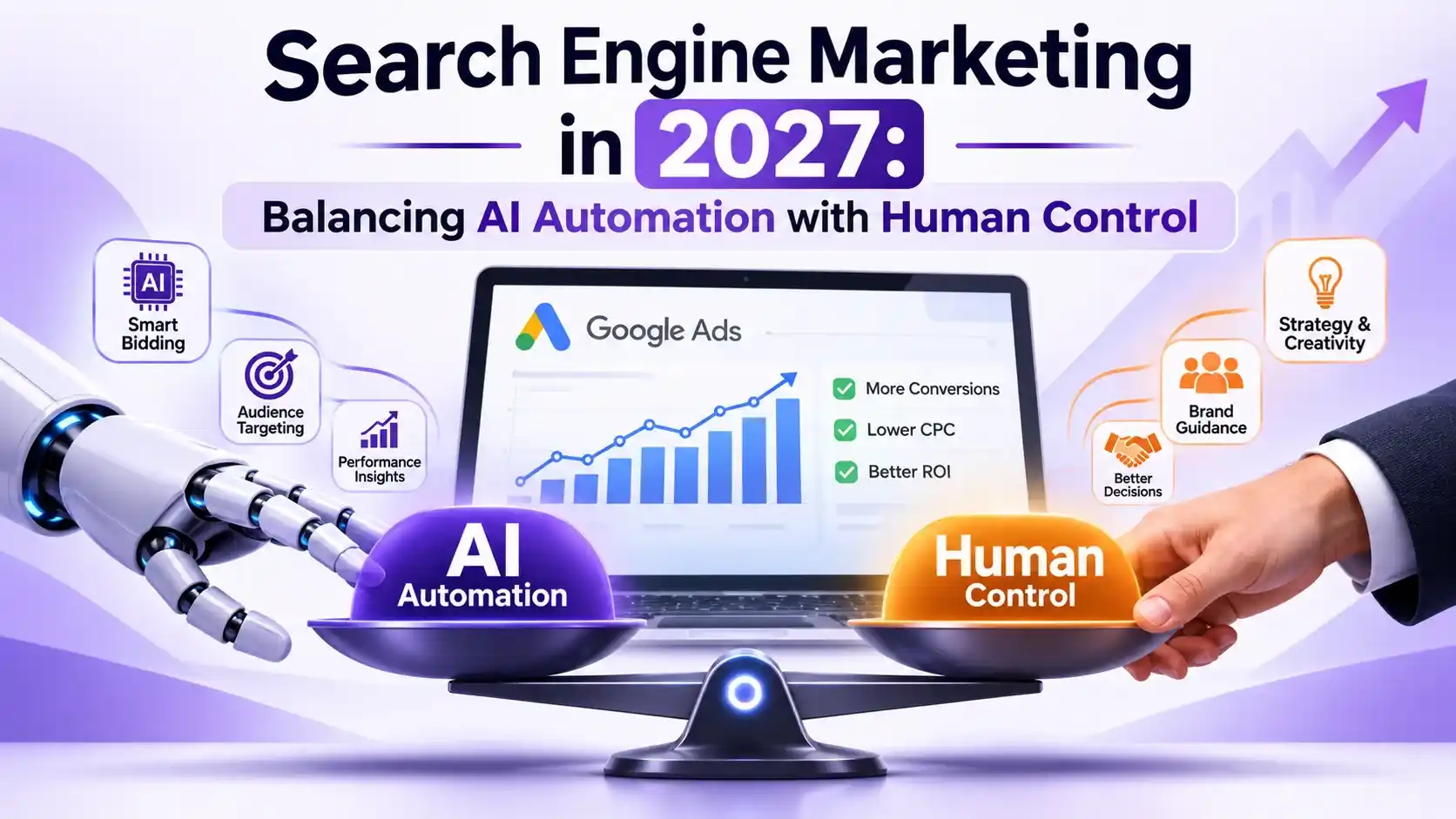
The most effective search engine marketing strategies in 2027 will likely combine AI-powered efficiency with human judgment, strategic planning, creativity, and accountability. Rather than allowing automation to manage everything independently, businesses should use AI as a tool that supports better marketing decisions.
This article explores how AI is changing search engine marketing, the benefits and limitations of automation, and practical strategies for maintaining the right balance between artificial intelligence and human control.
Recommended read: SEO in 2027: How AI Search Is Changing Organic Visibility
1. The Evolution of Search Engine Marketing
Search engine marketing has evolved significantly since businesses first started advertising on search engines. Traditional paid search campaigns required advertisers to manage nearly every aspect of their advertising activities manually.
Marketers researched keywords, selected match types, created advertisements, adjusted bids, selected locations, and analyzed campaign reports. Although these processes provided considerable control, they also required time, experience, and continuous monitoring.
As advertising platforms developed, automated features gradually became more sophisticated.
Modern advertising systems can now use machine learning to analyze user behavior, evaluate search intent, predict conversion probabilities, and adjust bids according to campaign objectives.
For example, Google Ads uses automated bidding strategies to optimize bids based on signals associated with individual auctions. Its AI Max features also introduce automated search term matching, text customization, and final URL expansion within existing Search campaigns.
Microsoft Advertising is also incorporating AI-powered capabilities into standard Search campaigns through its AI Max offering.
These developments demonstrate that search engine marketing is moving toward a model in which advertisers establish business objectives and strategic boundaries while AI handles more of the operational optimization.
Traditional SEM vs. AI-Powered SEM
| Traditional SEM | AI-Powered SEM |
|---|---|
| Manual bid adjustments | Automated bidding |
| Manual keyword expansion | AI-assisted search term matching |
| Manually written ad variations | AI-assisted ad customization |
| Manual audience analysis | Machine-learning-based audience signals |
| Manual performance reviews | Automated reporting and insights |
| Manual landing page selection | AI-assisted landing page selection |
| Periodic optimization | Continuous automated optimization |
Automation can reduce repetitive work, but traditional marketing knowledge remains important for setting campaign objectives and evaluating whether automated decisions support actual business goals.
2. How AI Automation Is Transforming Paid Search Advertising
AI is changing several important areas of search engine marketing. Its influence extends beyond automated bidding and includes targeting, advertising content, budget management, and performance analysis.
Understanding these capabilities helps businesses decide which activities should be automated and where human supervision is necessary.
Automated Bidding and Budget Optimization
Automated bidding is one of the most widely used AI applications in paid search advertising.
Instead of manually setting bids for every keyword, advertisers can use automated strategies to adjust bids according to campaign objectives.
Common Google Ads bidding strategies include:
Maximize Clicks: Focuses on generating as many clicks as possible within the available budget.
Maximize Conversions: Attempts to generate the highest possible number of conversions within the budget.
Target CPA: Optimizes bids toward a specified average cost per acquisition.
Target ROAS: Uses conversion value to optimize toward a desired return on advertising spend.
Maximize Conversion Value: Focuses on generating the highest possible conversion value within the budget.
AI-powered bidding systems analyze available auction-time signals and adjust bids accordingly.
For example, an e-commerce business may use conversion value optimization to prioritize users who are more likely to purchase higher-value products.
However, automated bidding depends heavily on the quality of conversion tracking and the data supplied to the platform. If purchase events are duplicated, leads are incorrectly recorded, or low-quality actions are treated as valuable conversions, automation may optimize toward the wrong outcome.
Human oversight is therefore necessary to ensure that bidding strategies reflect genuine business performance.
Intelligent Keyword and Search Term Matching
Keyword research remains an important part of search engine marketing, but AI is changing how advertising platforms identify relevant searches.
Traditional campaigns often relied on carefully selected keywords and match types. Modern AI-powered systems can use keyword context, landing page information, advertising assets, and other signals to discover additional relevant searches.
Google's AI Max for Search campaigns, for example, include search term matching capabilities that can extend beyond an advertiser's existing keyword list.
This creates opportunities to reach potential customers using search queries that marketers may not have identified during their initial research.
However, broader matching also creates risks.
An AI system may identify searches that appear relevant but do not have meaningful commercial intent. This can result in unnecessary spending.
Human marketers should regularly review search term reports, identify irrelevant queries, add negative keywords where appropriate, and evaluate whether new search opportunities align with business objectives.
AI-Generated Advertising Copy
Writing effective search advertisements requires understanding customer needs, communicating product benefits, and encouraging users to take action.
AI tools can help generate multiple headlines, descriptions, and messaging variations based on existing advertising assets and website content.
This can make ad creation faster and provide more opportunities for testing.
For example, a digital marketing agency could develop different advertising messages focused on:
- Increasing organic website traffic
- Generating qualified business leads
- Improving website performance
- Managing Google Ads campaigns
- Developing professional business websites
AI can generate variations for different search contexts, but human marketers should review the messaging before publication.
They need to ensure that advertisements are accurate, relevant, consistent with brand identity, and free from misleading promises.
Automated Landing Page Selection
Sending users to the right landing page is essential for successful search advertising.
A visitor searching for website development services should ideally arrive on a relevant service page rather than a general homepage.
AI-powered landing page features can help identify relevant website URLs based on search intent.
Google Ads AI Max includes Final URL expansion, which can select relevant landing pages from an advertiser's website.
Although this can improve relevance, businesses should carefully manage URL exclusions, monitor landing page performance, and ensure that automated selection does not send potential customers to outdated or inappropriate pages.
3. The Growing Importance of Human Control in AI Advertising
Despite significant improvements in automation, artificial intelligence cannot independently understand every business requirement.
An advertising platform may identify patterns that improve a particular campaign metric, but those improvements do not necessarily translate into higher profitability or long-term business growth.
Human marketers provide strategic direction, contextual understanding, and accountability.
Understanding Business Objectives
Every business has different advertising goals.
An e-commerce company may prioritize profitable sales, while a professional services company may focus on qualified leads and consultations.
A local business may want more telephone inquiries from customers within a specific geographic area.
AI can optimize campaigns based on the objectives and conversion signals provided to it. However, humans must determine which objectives matter most.
For example, maximizing the number of website form submissions may appear successful in an advertising dashboard. But if most submissions come from people who cannot afford the service, the campaign may not be commercially effective.
Human marketers need to distinguish between activity and meaningful business results.
Maintaining Brand Identity
Brand identity is another area where human supervision remains essential.
AI-generated advertisements may produce grammatically correct and relevant messages, but they may not consistently reflect a company's personality, communication style, or positioning.
Businesses should establish clear brand guidelines covering:
- Preferred language and tone
- Approved product and service descriptions
- Important brand messages
- Restricted or prohibited claims
- Target audience characteristics
- Advertising compliance requirements
These guidelines help ensure that automated content remains consistent with the company's identity.
Managing Advertising Budgets
AI can help distribute advertising budgets and optimize bids, but budget allocation should remain connected to broader financial planning.
Businesses need to consider profit margins, cash flow, customer acquisition costs, seasonal demand, and the lifetime value of customers.
For example, a campaign generating inexpensive leads may still be unprofitable if those leads rarely become paying customers.
Human marketers should establish budget limits, review spending patterns, and evaluate whether automated optimization is generating sustainable returns.
Protecting Customer Trust and Privacy
Advertising campaigns rely on data to understand customer behavior and improve targeting.
However, businesses must use customer information responsibly and comply with applicable privacy regulations and platform policies.
Human oversight is important when deciding what information should be collected, how it should be used, and which audiences should receive particular advertising messages.
AI should improve advertising relevance without compromising customer trust.
4. The Benefits of Combining AI Automation with Human Expertise
The strongest SEM strategies do not necessarily choose between automation and manual campaign management. Instead, they combine the strengths of both approaches.
AI offers processing speed, scalability, and pattern recognition. Human marketers contribute creativity, business understanding, and strategic decision-making.
Together, these capabilities can improve advertising operations.
Greater Campaign Efficiency
Automating repetitive tasks allows marketing teams to spend less time adjusting individual bids, creating routine reports, and reviewing large amounts of performance data manually.
They can focus more on strategy, customer research, creative development, and business growth.
Better Use of Advertising Data
AI systems can analyze large volumes of campaign information and identify trends that may be difficult to recognize through manual analysis.
Human experts can then investigate these findings and determine whether they represent genuine opportunities.
Improved Advertising Relevance
AI can help personalize advertising messages based on search context and available signals.
Human marketers ensure that personalization remains useful, appropriate, and consistent with the brand.
Faster Campaign Testing
AI-assisted advertising tools can help generate creative variations and support experimentation.
Marketing teams can test different messages, landing pages, and audience approaches to understand what works best.
More Scalable Campaign Management
Businesses managing multiple products, locations, or advertising campaigns can use automation to handle repetitive operational tasks.
Human specialists can concentrate on high-level planning and monitor important performance changes.
5. Where Human Marketers Should Maintain Direct Control
Not every marketing activity should be handed over to AI.
Some decisions have a significant impact on brand reputation, profitability, and customer relationships. These areas require direct human involvement.
| Marketing Activity | Recommended Approach |
|---|---|
| Keyword expansion | AI-assisted with human review |
| Bid optimization | Mostly automated with monitoring |
| Ad copy creation | AI-assisted with human approval |
| Budget allocation | Human-led with AI insights |
| Campaign objectives | Human-controlled |
| Negative keyword management | AI-assisted with human review |
| Landing page selection | Automated with URL controls |
| Brand messaging | Human-led |
| Conversion tracking | Human verification |
| Performance reporting | AI-assisted with human analysis |
| Advertising compliance | Human responsibility |
This approach provides a practical balance between efficiency and accountability.
The objective is not to prevent AI from making decisions. It is to ensure that automated decisions operate within boundaries established by knowledgeable marketers.
6. Data Quality Will Determine the Success of AI-Powered SEM
AI advertising systems depend on information to make optimization decisions.
The quality of that information can directly affect campaign performance.
For example, a business running lead generation campaigns may track form submissions as conversions. However, not every submission represents a genuine potential customer.
If an advertising platform receives only basic form submission data, it may optimize toward users who submit forms frequently rather than those who become paying customers.
This is why conversion tracking and data quality are becoming increasingly important.
Essential Data Practices for 2027
Implement accurate conversion tracking: Track meaningful actions such as completed purchases, qualified leads, and valuable customer interactions.
Remove duplicate events: Ensure that the same purchase or conversion is not counted multiple times.
Use enhanced conversion measurement where appropriate: Apply supported privacy-conscious measurement features to improve conversion reporting.
Connect offline outcomes: Where supported and compliant, import qualified leads, closed sales, or other offline conversion outcomes.
Review analytics regularly: Compare advertising platform reports with actual business records.
Maintain consistent attribution: Understand how different attribution models affect the way conversions are credited to advertising campaigns.
The goal is to provide advertising platforms with accurate signals so that automated systems optimize for valuable outcomes instead of misleading metrics.
7. The Role of Generative AI in Search Advertising Creativity
Generative AI is expanding the creative possibilities available to search marketers.
Businesses can use AI tools to brainstorm advertising concepts, create headline variations, develop promotional messages, and organize content for different customer segments.
This can reduce the time required to develop and test campaign assets.
However, generating more advertisements does not automatically improve performance.
Effective advertising still depends on understanding what customers value and how a business can solve their problems.
For example, a software company advertising project management tools may test different messaging approaches:
- Improve team productivity
- Organize projects more efficiently
- Simplify collaboration
- Manage business tasks in one platform
AI can help create variations of these messages, but marketers must determine which claims are accurate and which messages best represent the product.
Human Creativity Still Matters
Strong advertising often depends on insights that cannot be generated through data analysis alone.
Understanding customer frustrations, cultural differences, emotional motivations, and purchasing concerns requires meaningful research and human judgment.
AI should support the creative process rather than replace the people responsible for developing effective marketing communication.
8. How Small Businesses Can Use AI Without Losing Control
AI-powered search advertising is not limited to large companies with dedicated marketing departments.
Small businesses can also benefit from automation, particularly when they have limited time and resources.
However, smaller budgets require careful campaign management because unnecessary spending can quickly affect profitability.
A practical approach is to start with a clearly defined objective and gradually introduce automation.
Practical SEM Strategies for Small Businesses
Start with specific goals: Decide whether the campaign should generate calls, qualified leads, online sales, or store visits.
Research relevant keywords: Identify searches that indicate genuine interest in the product or service.
Use controlled automation: Test automated bidding and AI-powered campaign features with appropriate settings.
Set realistic budgets: Avoid spending beyond what the business can afford to invest in customer acquisition.
Create relevant landing pages: Ensure that advertisements lead visitors to pages that match their search intent.
Review search terms: Identify irrelevant searches and prevent unnecessary spending.
Monitor real conversions: Evaluate actual sales and qualified leads rather than relying only on clicks and impressions.
Test before expanding: Compare campaign performance over a meaningful period before increasing advertising budgets.
Small businesses should treat AI as a productivity tool, not as a replacement for understanding their customers and markets.
9. Measuring Search Engine Marketing Performance in 2027
As AI automation becomes more common, marketers need to evaluate campaign performance using more meaningful business metrics.
Traditional metrics such as impressions and clicks remain useful, but they do not provide a complete picture of advertising success.
A campaign can generate thousands of clicks without producing profitable customers.
Businesses should connect advertising performance with revenue, customer acquisition costs, and lead quality.
Important SEM Performance Metrics
| Metric | What It Measures |
|---|---|
| CTR | Percentage of impressions that generate clicks |
| CPC | Average cost per click |
| Conversion Rate | Percentage of visitors completing a desired action |
| CPA | Average cost per acquisition or conversion |
| ROAS | Revenue generated relative to advertising spend |
| Lead Quality | Relevance and potential value of generated leads |
| Customer Acquisition Cost | Total cost of acquiring a customer |
| Revenue | Income generated from advertising-driven customers |
| Profitability | Financial return after relevant costs |
Why Conversion Quality Matters More Than Conversion Volume
Consider a business spending $1,000 on two different advertising campaigns.
Campaign A generates 100 leads, but only five become customers.
Campaign B generates 40 leads, and 15 become customers.
Although Campaign A produces more leads, Campaign B delivers three times as many customers.
This example demonstrates why advertising optimization should focus on meaningful business outcomes rather than simply maximizing conversion volume.
10. Common Risks of Over-Automating Search Marketing
AI automation can improve efficiency, but excessive dependence on automated systems can create operational and strategic problems.
Businesses should understand these risks before allowing advertising platforms to manage campaigns with limited supervision.
Incorrect Conversion Signals
If conversion tracking is inaccurate, AI may optimize campaigns toward low-value actions.
Regular tracking audits help prevent this problem.
Irrelevant Search Traffic
Automated keyword expansion can introduce searches that are not closely related to a company's products or services.
Search term reviews, negative keywords, and appropriate targeting controls can help manage this risk.
Inconsistent Advertising Messages
Automatically generated advertisements may contain messaging that does not match a company's brand identity.
Human approval and clear messaging guidelines are important safeguards.
Uncontrolled Budget Expansion
Automated optimization should not be confused with unlimited spending authority.
Businesses need appropriate budget controls and regular financial reviews.
Reduced Strategic Understanding
Relying entirely on automated recommendations can prevent marketing teams from developing a deeper understanding of their customers and campaign performance.
Human marketers should continue researching customer behavior, evaluating market conditions, and identifying new opportunities.
Overlooking Landing Page Problems
Even highly optimized advertisements cannot compensate for a poor website experience.
Slow loading times, unclear service descriptions, complicated checkout processes, and weak calls to action can reduce conversions.
Businesses should evaluate the complete customer journey rather than focusing only on advertising platform performance.
11. A Practical Framework for Balancing AI Automation with Human Control
Businesses need a repeatable process for managing AI-powered search campaigns.
The following framework provides a structured approach for 2027.
Step 1: Define Business Objectives
Start by identifying the actual purpose of the advertising campaign.
Determine whether the primary goal is revenue, qualified leads, customer acquisition, or another measurable business outcome.
Step 2: Establish Measurement Standards
Configure conversion tracking and analytics before relying on automated bidding.
Verify that the platform receives accurate information about valuable customer actions.
Step 3: Introduce AI Automation Gradually
Start with selected automated features rather than changing every campaign setting simultaneously.
This makes it easier to identify which changes are improving or reducing performance.
Step 4: Establish Campaign Boundaries
Set appropriate budgets, geographic targeting, brand guidelines, URL exclusions, and other relevant restrictions.
These boundaries help automated systems operate within the business's requirements.
Step 5: Review Automated Decisions
Monitor search terms, advertising assets, landing pages, conversion data, and spending patterns.
Investigate unexpected changes rather than assuming that every automated adjustment is beneficial.
Step 6: Combine AI Insights with Human Analysis
Use automated reports to identify opportunities, but evaluate their commercial value before making major decisions.
Step 7: Test and Improve Continuously
Experiment with different messages, landing pages, bidding strategies, and targeting approaches.
Measure results against business objectives and make adjustments based on reliable evidence.
This framework allows businesses to benefit from automation without surrendering control over important marketing decisions.
12. The Future of Search Engine Marketing: What to Expect in 2027
Search engine marketing will continue evolving as AI becomes more deeply integrated into advertising platforms.
Although the exact direction of future developments cannot be predicted with certainty, several trends are likely to influence how businesses manage paid search campaigns.
More Advanced Automated Campaign Management
Advertising platforms will continue developing systems that automate targeting, bidding, creative optimization, and campaign analysis.
Marketers will increasingly focus on providing strategic guidance and evaluating business results.
Greater Use of Predictive Analytics
AI-powered systems may provide more sophisticated estimates of conversion opportunities, customer behavior, and potential campaign outcomes.
Businesses will be able to use these insights to make better-informed marketing decisions.
More Personalized Advertising Experiences
Search advertising is likely to become more context-aware, with messages adapting to user intent and available information.
Advertisers will need to maintain relevance without compromising customer privacy.
Stronger Integration Across Marketing Channels
Search advertising will increasingly operate alongside other digital marketing channels, including social media, email marketing, video advertising, and analytics platforms.
Businesses will need to understand how these channels work together throughout the customer journey.
Greater Importance of Transparency and Measurement
As automation becomes more sophisticated, advertisers will need clearer reporting and stronger measurement practices.
Understanding why campaigns generate particular results will remain important for managing advertising investments.
Human Expertise Will Become More Strategic
The role of search marketers is likely to shift away from repetitive campaign adjustments toward strategic planning, data interpretation, customer research, creative direction, and performance accountability.
The ability to work effectively with AI tools will become an important marketing skill.
Frequently Asked Questions (FAQs)
1. What is search engine marketing in 2027?
Search engine marketing in 2027 involves using paid search advertising and increasingly sophisticated AI-powered tools to reach potential customers through search platforms. It combines keyword targeting, automated bidding, advertising optimization, audience insights, and human strategic management.
2. How is AI changing search engine marketing?
AI is changing SEM through automated bidding, search term matching, predictive analytics, ad copy customization, audience signals, and landing page optimization. These capabilities help advertisers manage campaigns more efficiently and respond to changing user behavior.
3. Will AI replace search engine marketers?
AI is unlikely to eliminate the need for skilled search marketers. Although automation can manage many repetitive tasks, businesses still need human expertise for strategy, creative decisions, customer understanding, budget management, and accountability.
4. What is the difference between automated bidding and manual bidding?
Manual bidding requires advertisers to set and adjust bids themselves. Automated bidding uses machine learning and available auction-time signals to adjust bids according to selected campaign objectives.
5. Should small businesses use AI-powered Google Ads campaigns?
Yes, small businesses can benefit from AI-powered advertising features, provided they have clear objectives, accurate conversion tracking, appropriate budgets, and regular campaign monitoring. Automation should be introduced carefully rather than activated without a strategy.
6. How can marketers maintain control over AI advertising?
Marketers can maintain control by setting campaign objectives, defining budgets, reviewing search terms, applying brand guidelines, managing URL exclusions, verifying conversion data, and monitoring advertising performance.
7. Is AI-generated advertising copy effective?
AI-generated advertising copy can help businesses develop relevant variations quickly. However, human review is important to ensure accuracy, brand consistency, appropriate messaging, and compliance with advertising policies.
8. What are the biggest risks of AI automation in SEM?
Important risks include inaccurate conversion tracking, irrelevant search traffic, misleading advertising messages, excessive spending, poor landing page selection, and dependence on automated recommendations without sufficient human review.
9. What skills will search engine marketers need in 2027?
Important skills will include AI tool management, data analysis, conversion tracking, strategic planning, keyword research, creative development, customer research, budget management, and campaign performance evaluation.
10. How can businesses measure the success of AI-powered search campaigns?
Businesses should evaluate conversions, qualified leads, cost per acquisition, return on advertising spend, customer acquisition costs, revenue, and profitability. Clicks and impressions are useful supporting metrics but should not be the only measures of success.
Conclusion
Search engine marketing in 2027 will be shaped by the growing relationship between artificial intelligence and human expertise. AI-powered advertising platforms are making campaign management faster, more data-driven, and increasingly automated. Businesses can use these capabilities to discover relevant search opportunities, improve advertising messages, optimize bids, and manage campaigns more efficiently.
However, automation alone does not guarantee successful marketing outcomes. AI systems need accurate data, clear objectives, appropriate boundaries, and continuous evaluation. Without human supervision, businesses may spend money on irrelevant traffic, attract low-quality leads, or deliver advertising messages that do not reflect their brand.
The most effective approach combines AI's ability to process information and automate repetitive tasks with human creativity, strategic thinking, and business understanding.
In 2027, successful search engine marketers will not simply be those who use the most automation. They will be the professionals who know when to trust AI, when to question its recommendations, and when to let human judgment guide the final decision.
AI can optimize advertising operations, but humans must define what success means.