Introduction
Search engine optimization is entering a new era. For years, businesses and website owners focused on ranking their pages on Google's first page, targeting relevant keywords, building backlinks, and improving website performance. However, the rapid development of artificial intelligence is changing how people discover information, compare products, and make purchasing decisions online.
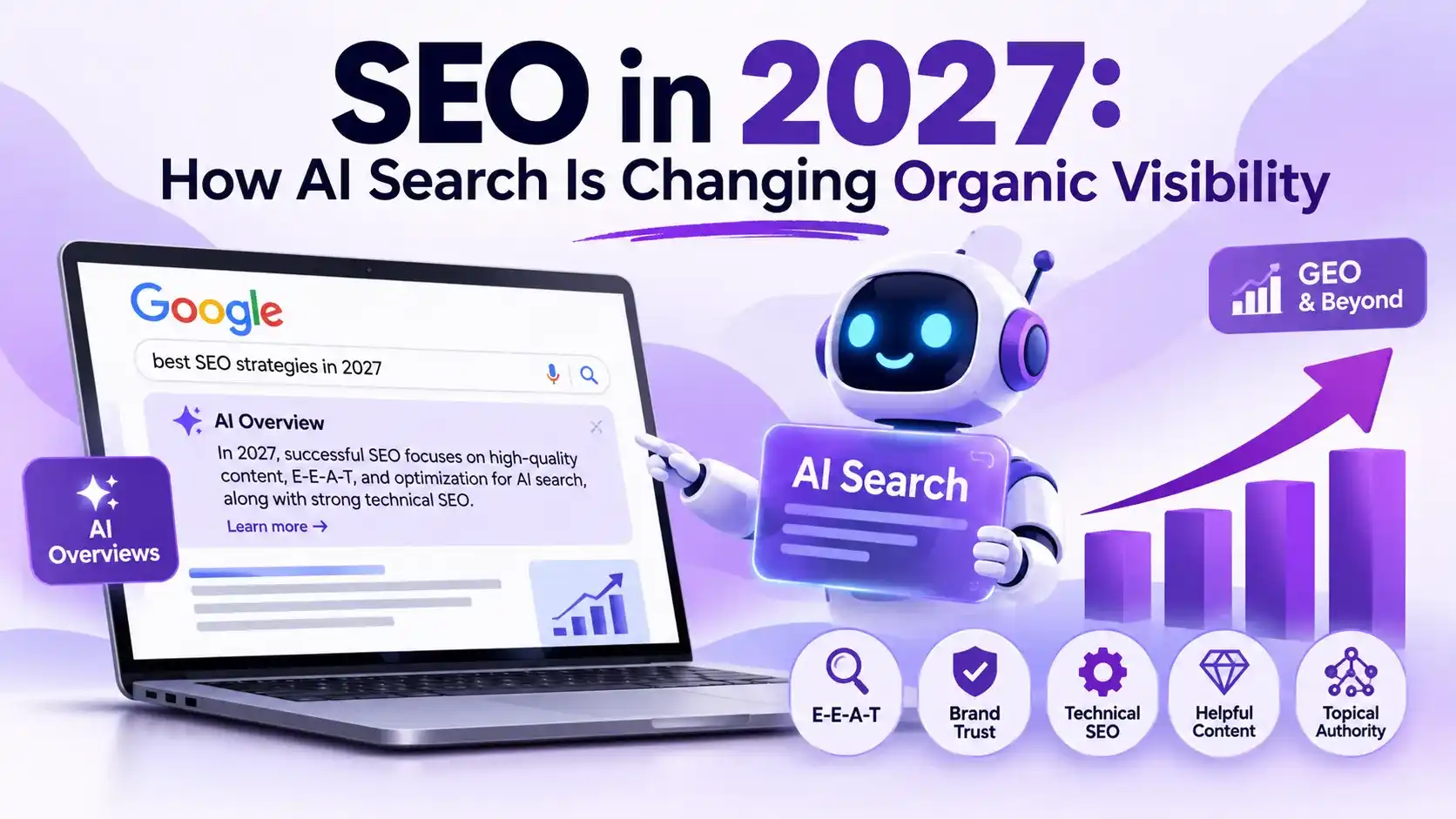
In 2027, organic visibility will no longer be determined solely by traditional search engine rankings. AI-powered search experiences, including Google's AI Overviews, AI Mode, Microsoft Copilot, and conversational search platforms, are changing how search results are presented and consumed.
Instead of displaying only a list of website links, AI-powered search engines can generate direct answers by gathering information from multiple sources. They may also recommend websites, reference expert opinions, compare products, and provide links to relevant resources.
This transformation creates both opportunities and challenges for businesses, publishers, and digital marketers. Websites must now compete for traditional search rankings while also building visibility in AI-generated answers.
The future of SEO will depend on a combination of high-quality content, technical optimization, brand authority, user experience, and the ability to provide information that AI systems can understand and trust.
This article explores the major SEO changes expected in 2027 and explains how businesses can adapt their organic search strategies to remain competitive.
Recommended read: AI Search vs Traditional Search: How Users Will Find Information in 2026
1. The Shift From Traditional Search to AI-Powered Search
Traditional search engines generally provide a list of webpages based on relevance, quality, and other ranking signals. Users enter a keyword, review the available results, and visit websites to find the information they need.
AI-powered search introduces a different experience. Rather than requiring users to visit multiple websites, AI systems can summarize information, answer questions, and present relevant sources within a single response.
For example, someone searching for "best SEO strategies for small businesses" might previously have received several blog articles and guides. With AI-powered search, the user may receive an organized overview covering keyword research, local SEO, content marketing, technical SEO, and link building.
The response may also include links to websites that provide useful supporting information.
This change affects how businesses approach organic visibility. Ranking in traditional search results remains important, but being selected as a trusted source in AI-generated responses is becoming another valuable opportunity.
Why AI Search Matters for Businesses
AI search is changing the relationship between search engines, websites, and users.
Some important developments include:
- Direct answers: Users can receive answers without opening multiple webpages.
- Conversational queries: People can ask detailed questions using natural language.
- Source recommendations: AI platforms can reference websites that support their answers.
- Contextual discovery: Search systems can understand the meaning and intent behind complex queries.
- More specific searches: Users can explore products, services, and solutions through follow-up questions.
Businesses that create genuinely useful information and establish strong online authority will be better positioned to benefit from these developments.
2. AI Overviews and Their Impact on Organic Rankings
Google's AI Overviews represent one of the most important developments in modern search. These AI-generated summaries appear for selected searches and provide users with an overview of relevant information, often accompanied by links to supporting websites.
This changes the way users interact with traditional search results.
When an AI Overview answers a question directly, some users may not need to click through to individual websites. As a result, websites targeting basic informational queries may experience changes in impressions, click-through rates, and organic traffic.
However, AI Overviews can also introduce websites to users who might not otherwise discover them through traditional rankings.
For businesses, the objective should be to create content that offers enough value to encourage users to explore the original website.
How to Improve Visibility in AI Overviews
There is no guaranteed method for appearing in Google's AI-generated responses. However, businesses can strengthen their eligibility and overall search visibility by following established SEO practices.
Consider these approaches:
- Answer questions clearly: Provide direct, accurate answers to important user questions.
- Use descriptive headings: Organize information with relevant H2 and H3 headings.
- Provide supporting details: Explain concepts with examples, statistics, and practical recommendations.
- Demonstrate expertise: Include genuine industry knowledge and first-hand experience.
- Maintain accurate information: Review and update outdated content.
- Improve technical accessibility: Ensure search engines can crawl and index important website pages.
Google's guidance confirms that traditional SEO fundamentals remain relevant to AI search experiences. Websites do not need separate AI-specific ranking tricks to become eligible for AI Overviews or AI Mode.
3. Generative Engine Optimization (GEO) Is Becoming More Important
Generative Engine Optimization, commonly known as GEO, refers to improving a brand's visibility within AI-generated answers and conversational search experiences.
Traditional SEO primarily focuses on improving visibility in search engine results pages. GEO expands the objective by considering how AI systems discover, interpret, select, and reference information.
For example, imagine a company offering website development services. A potential customer asks an AI search platform:
"Which companies provide reliable custom web development services for small businesses?"
The AI platform may generate recommendations based on available information about different companies, their services, expertise, reputation, and online presence.
A business with clear service pages, detailed case studies, positive customer feedback, and consistent brand information may have more opportunities to be recognized as a relevant source.
Important GEO Strategies for 2027
Create authoritative content: Publish detailed articles that demonstrate genuine knowledge of your industry.
Build brand recognition: Maintain consistent business information across your website, professional directories, and relevant online platforms.
Include original insights: Share research, case studies, expert opinions, and practical examples rather than repeating existing articles.
Improve content clarity: Use descriptive headings, informative paragraphs, lists, and clearly explained concepts.
Earn relevant mentions: Build relationships with reputable industry publications and websites that may reference your business or expertise.
GEO should complement traditional SEO rather than replace it. Strong search fundamentals remain essential for helping AI-powered systems discover and understand website content.
4. Search Intent and Conversational Keywords Will Shape Content Strategies
Keyword research has always been an important part of SEO. However, search behavior is becoming more conversational as users interact with AI-powered search tools.
Instead of entering short phrases such as "SEO agency Lahore," users may ask detailed questions such as:
- Which SEO agency can help a small business increase organic traffic?
- How much does professional SEO cost for an e-commerce website?
- What is the difference between traditional SEO and AI search optimization?
- How long does it take to improve Google rankings?
- Which SEO strategies are most effective for local businesses?
These longer searches provide more information about the user's needs and expectations.
In 2027, successful content strategies will need to address complete search journeys rather than focus exclusively on individual keywords.
How to Optimize Content for Conversational Search
Start by identifying the questions your target audience asks before making a decision.
Use keyword research tools, customer conversations, website search data, and industry discussions to identify common problems.
Organize content around related topics and user questions. For example, an article about e-commerce SEO could include sections covering product page optimization, technical SEO, keyword research, category pages, and conversion optimization.
This approach helps businesses create comprehensive resources that address multiple aspects of a subject.
However, avoid creating dozens of nearly identical pages simply to target different keyword variations. Each page should provide a distinct benefit to readers.
5. Topical Authority Will Become a Competitive Advantage
Publishing individual blog posts is not enough to establish a strong online presence. Search engines increasingly need to understand what a website specializes in and whether its content demonstrates meaningful expertise.
Topical authority refers to the depth and relevance of a website's coverage of a particular subject.
For example, a website focusing on digital marketing could publish interconnected resources about:
- Search engine optimization
- Technical SEO
- Local SEO
- Content marketing
- Link building
- AI search optimization
- Google Analytics
- Search engine algorithm updates
These articles can support one another through relevant internal links and organized category structures.
Building Topical Authority
A practical approach involves developing topic clusters.
A pillar page covers a broad subject, while supporting articles explore specific areas in greater detail.
For example:
Main topic: Search Engine Optimization
Supporting articles:
- Complete Guide to Technical SEO
- Keyword Research Strategies for 2027
- How to Improve Website Organic Traffic
- Local SEO Strategies for Small Businesses
- Link Building Techniques That Support SEO
- How AI Search Is Changing Organic Visibility
Each supporting article should provide meaningful information and link to other relevant resources where appropriate.
This structure helps visitors navigate related information and makes the website's subject coverage easier to understand.
6. High-Quality Content Will Matter More Than AI-Generated Content Volume
Artificial intelligence has made content production faster and more accessible. Businesses can now use AI tools to research topics, generate outlines, improve readability, and develop initial article drafts.
However, easier content production also creates a major challenge: the internet is becoming increasingly crowded with similar articles that repeat the same information.
Publishing more content does not automatically improve organic rankings.
In 2027, businesses should focus on producing original, helpful, and trustworthy content rather than publishing large volumes of generic AI-generated articles.
What Makes Content Valuable?
High-quality content should provide something readers cannot easily find in dozens of competing articles.
Consider incorporating:
- Original research and industry statistics
- First-hand experiences and practical examples
- Expert opinions and professional recommendations
- Detailed tutorials and step-by-step instructions
- Real customer questions and solutions
- Relevant images, videos, and supporting resources
For example, an article about website speed optimization becomes more useful when it includes actual performance testing, before-and-after results, and practical recommendations.
Simply explaining what website speed means provides limited additional value.
Using AI Without Compromising Content Quality
AI tools can support content creation, but human review remains essential.
A responsible AI-assisted content workflow should include:
- Researching the topic and identifying search intent.
- Creating a detailed content outline.
- Using AI to support research and drafting.
- Verifying facts, statistics, and technical recommendations.
- Adding original insights and relevant examples.
- Optimizing headings, metadata, and internal links.
- Reviewing the final article for accuracy, clarity, and usefulness.
Google's guidance on generative AI content emphasizes accuracy, quality, relevance, and originality. Using AI is not automatically a violation of search policies, but producing large numbers of low-value pages without meaningful user benefit can create problems.
7. E-E-A-T and Brand Trust Will Remain Important
E-E-A-T stands for Experience, Expertise, Authoritativeness, and Trustworthiness.
These concepts are part of Google's Search Quality Rater Guidelines and provide a useful framework for evaluating content quality.
As AI-generated information becomes more common, demonstrating credibility and genuine expertise will become increasingly valuable.
Users want to know whether information comes from a reliable source, especially when making financial, business, health, or purchasing decisions.
Ways to Strengthen E-E-A-T
Show author information: Include relevant author biographies and professional experience.
Publish accurate information: Support important claims with reliable sources and current research.
Demonstrate real experience: Include case studies, original examples, and practical industry insights.
Maintain transparency: Provide clear contact information, company details, editorial policies, and relevant disclosures.
Build a strong reputation: Earn legitimate references, reviews, and mentions from relevant websites and publications.
Keep content updated: Review important pages regularly to ensure that recommendations and information remain accurate.
Trust is not established through a single SEO technique. It develops through consistent publishing, transparent business practices, expertise, and positive user experiences.
8. Technical SEO Will Continue to Support AI Search Visibility
Although AI is changing how search results are presented, technical SEO remains essential.
AI-powered search systems still need to discover, access, interpret, and retrieve information from websites. If important pages cannot be crawled or indexed, their visibility opportunities may be limited.
A technically optimized website provides a stronger foundation for traditional and AI-powered search experiences.
Technical SEO Priorities for 2027
Crawlability and indexability: Check robots.txt, XML sitemaps, canonical tags, and indexing directives.
Website speed: Improve loading performance and reduce unnecessary scripts and resources.
Mobile usability: Ensure that important content and website functionality work correctly across mobile devices.
HTTPS security: Use secure connections and maintain website security.
Structured data: Implement relevant schema markup, such as Organization, Article, Product, and BreadcrumbList, where appropriate.
Internal linking: Make important pages accessible through logical internal links.
JavaScript SEO: Ensure that important content and links can be discovered and processed by search engines.
Content accessibility: Keep important information available in readable text instead of relying entirely on images or inaccessible visual elements.
It is important to understand that structured data does not guarantee inclusion in AI-generated answers. Google has also clarified that no special schema markup is required specifically for AI Overviews or AI Mode.
Technical optimization should support accessibility, content discovery, and a better user experience.
9. Zero-Click Searches Will Change How Organic Success Is Measured
Zero-click searches occur when users receive enough information directly from a search experience without visiting an external website.
Featured snippets, knowledge panels, AI Overviews, and other search features can contribute to this behavior.
For website owners, this creates an important measurement challenge.
A website may receive impressions and brand exposure without generating an equivalent increase in organic clicks.
This means businesses should avoid evaluating SEO performance using website traffic alone.
Important SEO Metrics to Track in 2027
| Metric | What It Measures |
|---|---|
| Organic clicks | Visitors arriving through unpaid search results |
| Search impressions | How frequently website pages appear in search results |
| Click-through rate | Percentage of impressions generating clicks |
| Keyword visibility | Search presence for relevant target keywords |
| AI citations | How frequently a website is referenced in AI-generated answers |
| Referral traffic | Visitors coming from external platforms |
| Conversions | Leads, sales, subscriptions, or other valuable actions |
| Brand searches | Search interest in a specific business or brand |
Businesses should also monitor engagement and conversion quality. A smaller number of relevant visitors may generate more revenue than a large volume of unrelated traffic.
10. AI Search Visibility Requires a Strong Brand Presence
Search visibility is no longer limited to individual webpages.
People discover businesses through search engines, AI assistants, online communities, social media platforms, review websites, and industry publications.
A consistent digital presence helps customers recognize a business and find reliable information about its services.
For example, a digital marketing agency should maintain:
- A professional and informative website
- Detailed service pages
- Relevant industry articles
- Genuine client testimonials
- Case studies demonstrating results
- Updated business profiles
- Consistent company information
- Relevant mentions from trusted industry sources
Businesses should also invest in building their reputation beyond their own websites.
Relevant industry contributions, partnerships, professional discussions, and legitimate media mentions can help establish brand recognition.
The objective is not to generate artificial mentions across as many websites as possible. It is to develop a recognizable brand with a credible digital footprint.
11. Video, Images, and Other Multimedia Will Support Search Visibility
Search experiences are becoming more visual and interactive. Users increasingly expect information through videos, product demonstrations, tutorials, comparison images, and other multimedia formats.
Text remains important, but supporting content with relevant visual resources can improve understanding and user engagement.
For example, a website publishing an article about technical SEO could include:
- Screenshots of Google Search Console
- Website speed testing results
- Technical SEO audit examples
- Short instructional videos
- Infographics explaining optimization processes
E-commerce websites can also benefit from original product photography, demonstration videos, detailed product information, and comparison guides.
Multimedia SEO Best Practices
- Use descriptive image filenames.
- Write meaningful alternative text for informative images.
- Compress images without sacrificing necessary quality.
- Add relevant video titles and descriptions.
- Use appropriate image dimensions and formats.
- Include useful captions and supporting explanations.
- Create video transcripts when appropriate.
Multimedia should support the actual topic rather than exist solely to increase page length.
12. AI Agents May Introduce New Opportunities for Businesses
Another development worth watching in 2027 is the growth of AI agents.
Unlike traditional search tools that primarily retrieve information, AI agents can increasingly help users complete tasks.
Depending on the platform and available integrations, these systems may compare products, gather business information, evaluate service options, or assist with purchasing and booking processes.
For example, a customer might ask an AI assistant to compare three website hosting providers based on pricing, storage, performance, and customer support.
An AI agent may then gather information from different websites and help the customer evaluate the available options.
This creates new considerations for website owners.
Businesses should make their essential information easy to discover and understand.
For service providers, this means maintaining accurate service descriptions, pricing information where appropriate, contact details, and clear explanations of business offerings.
For e-commerce businesses, accurate product names, descriptions, specifications, availability, and structured product information can become particularly important.
Although agent-driven discovery is still evolving, preparing websites with clear information and accessible functionality is a sensible long-term strategy.
13. A Practical SEO Strategy for Businesses in 2027
Adapting to AI search does not require abandoning existing SEO practices. Instead, businesses should strengthen their foundations and expand their strategies to account for changing search behavior.
The following roadmap provides a practical starting point.
Step 1: Conduct a Complete SEO Audit
Review your website's technical health, indexing status, page speed, mobile usability, existing content, backlinks, and internal linking structure.
Identify pages with declining traffic and opportunities to improve existing content.
Step 2: Research Keywords and Search Intent
Identify the terms and questions your potential customers use when searching for your products or services.
Focus on relevant topics, conversational searches, long-tail keywords, and commercial search intent.
Step 3: Develop Topic Clusters
Build a structured content plan around your main business topics.
Create comprehensive pillar pages and supporting articles that address specific customer questions.
Step 4: Publish Original and Helpful Content
Prioritize accuracy, expertise, practical examples, and unique insights.
Use AI tools to improve productivity, but ensure that every published page provides genuine value.
Step 5: Strengthen Brand Authority
Publish useful resources, collect genuine customer reviews, build relevant industry relationships, and maintain consistent business information.
Step 6: Improve Technical Accessibility
Make sure search engines can crawl and index your important pages.
Use relevant structured data, optimize page experience, and maintain a logical website structure.
Step 7: Monitor Traditional and AI Search Visibility
Track organic performance through Google Search Console and analytics tools.
Where available, use AI visibility reporting in platforms such as Google Search Console and Bing Webmaster Tools to understand how your content appears in generative search experiences.
Step 8: Optimize Based on Business Results
Evaluate which pages attract qualified visitors, generate leads, and contribute to revenue.
Update your strategy based on actual performance rather than focusing exclusively on keyword positions.
14. Common SEO Mistakes to Avoid in 2027
As AI search becomes more prominent, businesses may be tempted to adopt shortcuts that promise immediate visibility.
However, many tactics can waste resources or damage long-term search performance.
Avoid these common mistakes:
Publishing mass-produced AI articles: Large quantities of repetitive content do not automatically create topical authority.
Ignoring traditional SEO: Technical SEO, keyword research, internal linking, and quality backlinks still matter.
Targeting keywords without understanding intent: Content must address what users actually want to accomplish.
Creating artificial backlinks: Irrelevant or manipulative link-building practices can create search policy risks.
Ignoring brand reputation: A website needs more than optimized articles to establish credibility.
Overusing keywords: Unnatural keyword repetition reduces readability and does not create meaningful value.
Following unverified GEO hacks: No third-party tool can guarantee that a particular optimization technique will make an AI system cite a website.
Ignoring performance data: Businesses should evaluate real search visibility, engagement, and conversions rather than relying on assumptions.
A sustainable SEO strategy should focus on users, reliable information, and long-term business objectives.
15. The Future of Organic Visibility: What Businesses Should Expect
The future of SEO will likely involve a combination of traditional search results, AI-generated summaries, conversational discovery, and agent-assisted experiences.
The way people find information will continue to evolve, but their underlying needs will remain familiar. They want accurate answers, trustworthy recommendations, relevant products, and solutions to real problems.
Businesses that understand these needs will have opportunities to build sustainable organic visibility.
Several developments deserve attention in 2027:
- AI-powered search will continue influencing how users discover websites.
- Brand recognition and reputation will become increasingly important.
- Original research and first-hand experience will help differentiate content.
- Search intent will remain central to successful content strategies.
- Technical SEO will continue supporting content discovery.
- AI visibility and traditional organic performance will need to be evaluated together.
- Businesses will need to focus more on qualified traffic and conversions.
Rather than treating AI search as a replacement for SEO, businesses should view it as an expansion of the search ecosystem.
The most effective strategies will combine established SEO fundamentals with a deeper understanding of AI-powered discovery.
Frequently Asked Questions (FAQs)
1. Will SEO still be important in 2027?
Yes. SEO will remain important because people will continue using search engines and AI-powered platforms to discover information, products, and services. However, businesses will need to optimize for a broader range of search experiences rather than focusing exclusively on traditional rankings.
2. What is AI search optimization?
AI search optimization involves improving a website's discoverability and the usefulness of its information across AI-powered search experiences. It includes creating authoritative content, improving technical accessibility, providing accurate information, and building brand credibility.
3. What is the difference between SEO and GEO?
Traditional SEO focuses on improving a website's visibility in search engine results. GEO focuses on improving the likelihood of a brand or its content being discovered, referenced, or recommended in generative AI responses. Both approaches can work together.
4. Will AI Overviews reduce organic website traffic?
AI Overviews may reduce clicks for certain searches when users find sufficient information directly in search results. However, they can also introduce users to relevant websites. The impact depends on search intent, topic, industry, and the type of content displayed.
5. How can a website appear in AI-generated answers?
Start with strong SEO fundamentals. Make sure important pages are crawlable and indexed, publish original and helpful information, demonstrate expertise, and organize content clearly. There is no guaranteed method for securing an AI citation.
6. Does AI-generated content hurt SEO?
Not automatically. AI can support research, outlining, and content development. However, publishing inaccurate, repetitive, or low-value content at scale can violate Google's spam policies. Human review and meaningful original contributions are essential.
7. Are backlinks still important for SEO in 2027?
Backlinks remain useful for discovery, authority, and understanding relationships between websites. Businesses should prioritize relevant, trustworthy links earned through valuable content, legitimate partnerships, and industry contributions rather than purchasing large volumes of low-quality links.
8. What is the best SEO strategy for small businesses in 2027?
Small businesses should focus on local SEO, relevant service pages, helpful content, genuine customer reviews, technical website optimization, and a consistent brand presence. Targeting specific customer needs is often more effective than competing for broad, highly competitive keywords.
9. How can businesses measure AI search visibility?
Businesses can monitor traditional organic performance through Google Search Console and analytics platforms. They can also use available AI visibility reports, including reporting in Bing Webmaster Tools, to track citations and appearances in supported AI search experiences.
10. Should businesses invest in GEO services?
Businesses that depend on organic discovery should understand how AI search affects their industry. GEO can be incorporated into a broader SEO strategy, but services should focus on measurable improvements in content quality, brand visibility, technical accessibility, and qualified traffic rather than guaranteed AI rankings.
Conclusion
SEO in 2027 will be about more than achieving first-page rankings. AI-powered search is changing how information is discovered, summarized, and recommended, creating new opportunities for businesses that invest in useful content and strong digital authority.
Traditional SEO remains the foundation. Websites still need to be crawlable, technically sound, relevant, and valuable to their audiences. However, businesses should also pay attention to brand recognition, original research, conversational search, AI-generated answers, and changing user expectations.
The most sustainable approach is to create a website that serves people first while making its information accessible to search engines and AI-powered discovery systems.
Businesses that consistently demonstrate expertise, publish trustworthy information, and deliver meaningful user experiences will be better prepared for the evolving search landscape.
The future of SEO is not simply about ranking a webpage. It is about becoming a trusted source that people and AI-powered search experiences can discover, understand, and recommend.